


Facts rather than assumptions: new insights into CO₂ emissions from recreational boating
Just how high are CO₂ emissions from recreational boating in the Netherlands? And where do the greatest opportunities for sustainability lie? These questions were central to a new study by the Centre for Sustainability, Tourism and Transport (CSTT) at Breda University of Applied Sciences, carried out by Eke Eijgelaar on behalf of Waterrecreatie Nederland, with support from HISWA-RECRON and CELTH.
The study was prompted by the need for a reliable baseline measurement of fuel consumption and CO₂ emissions from recreational craft. “The data available on this subject was very limited. Policy and reports often relied on rough assumptions and severely outdated figures,” says Eijgelaar. “Yet the sector is actively working towards sustainability and needs a realistic starting point.”
From models to actual consumption
What distinguishes this study from previous ones is its bottom-up approach. Instead of calculating emissions based on average engine power and estimated sailing hours, the figures are based on self-reported, actual fuel consumption by users. A total of 819 recreational boaters completed a detailed survey covering the 2023 sailing season, the results of which have been analysed for cabin sailing boats, cabin motorboats and sloops.
“The biggest difference is that we have calculated CO₂ emissions based on the litres of fuel that people actually say they have used,” says Eijgelaar. “That makes it possible to compare technical models with real-world practice.”
A second innovative element is that transport to and from the boat has also been included. From previous tourism and mobility studies, Eijgelaar knew that this ‘journey to and from’ can account for a significant proportion of the total carbon footprint. “Sailing alone does not constitute the entire trip,” he emphasises. “For some groups, transport emissions turned out to be almost as high as those from sailing itself.”
Major differences between and within vessel types
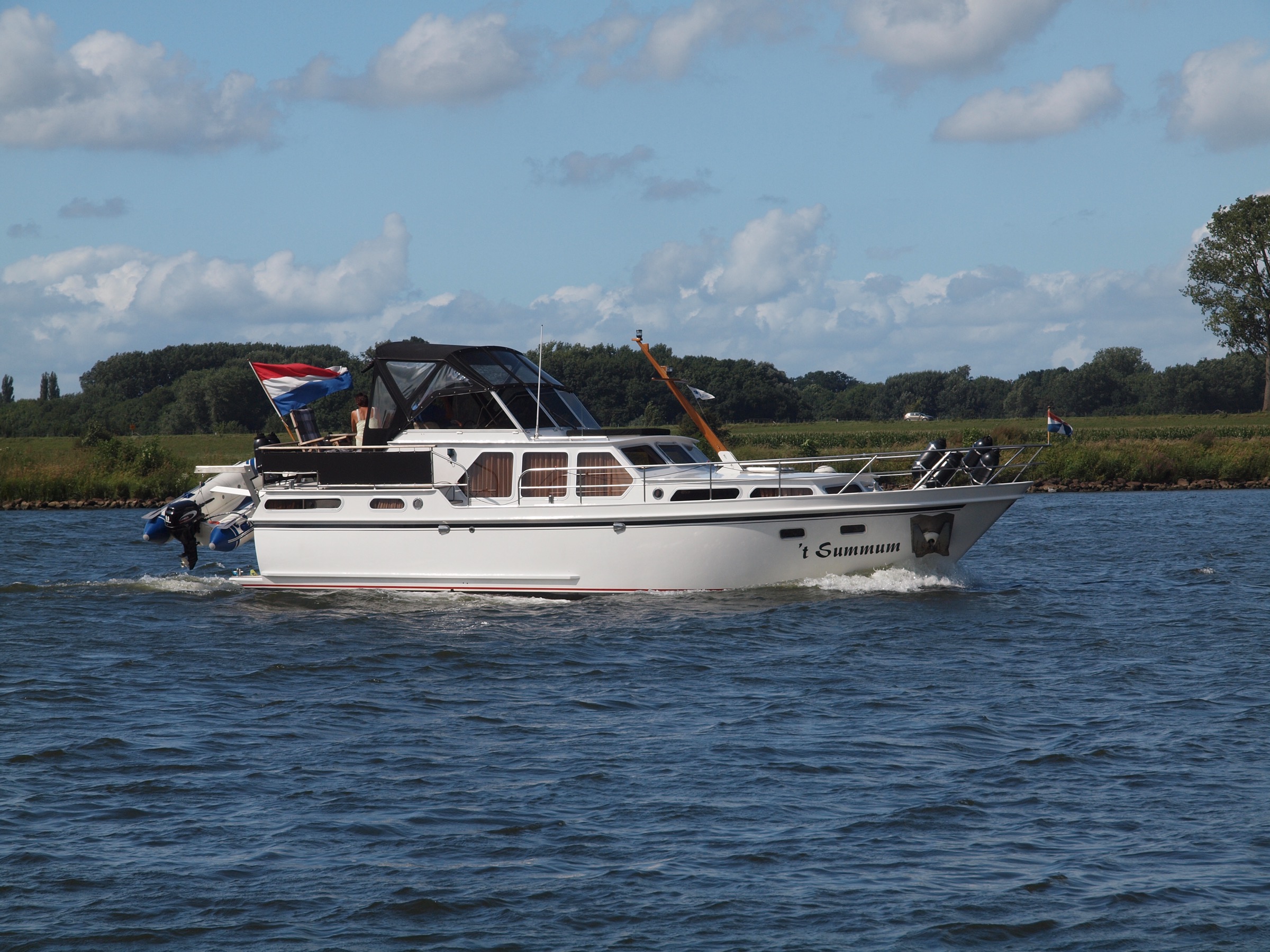
The results show that total CO₂ emissions vary greatly by vessel type. Cabin motorboats cause by far the most emissions on average, mainly due to their higher engine power and greater number of engine hours. Emissions are considerably lower for cabin sailing boats and sloops. For cabin sailing boats, transport to the mooring plays a relatively larger role; for sloops, it plays a smaller role.
The enormous variation within the groups is also striking. “You can see that a small number of frequent users and high-consumption vessels are pushing the average emissions figures up significantly,” says Eijgelaar. “If you remove a few outliers from the data set, the average emissions drop sharply. This is very similar to what we see in aviation: a small group of frequent flyers accounts for a large proportion of emissions.”
Guidance for policy and monitoring
The research is emphatically not an end point. Eijgelaar developed a simple calculation model for Waterrecreatie Nederland that will enable the sector to continue monitoring fuel consumption and emissions itself in the coming years. “In principle, all you need to do is ask people how many litres of fuel they have used and what type of fuel,” he says. “Then you can very easily track trends and evaluate policy.”
According to Eijgelaar, the research thus primarily provides a solid knowledge base for next steps. Not only for further monitoring, but also for questions such as: where are the greatest opportunities for sustainability, which user groups should be targeted, and what role do alternative fuels or behavioural change play?
“We now know a great deal about the emissions themselves,” he concludes. “The next step is to look at: what is standing in the way of a faster transition to sustainability in recreational boating, and how can we remove those barriers? That’s where CELTH and CSTT have a valuable role to play.”
Download the report (Dutch) on the projectpage