

INTERIM: Integrating Tourism and Leisure into Mobility Policy
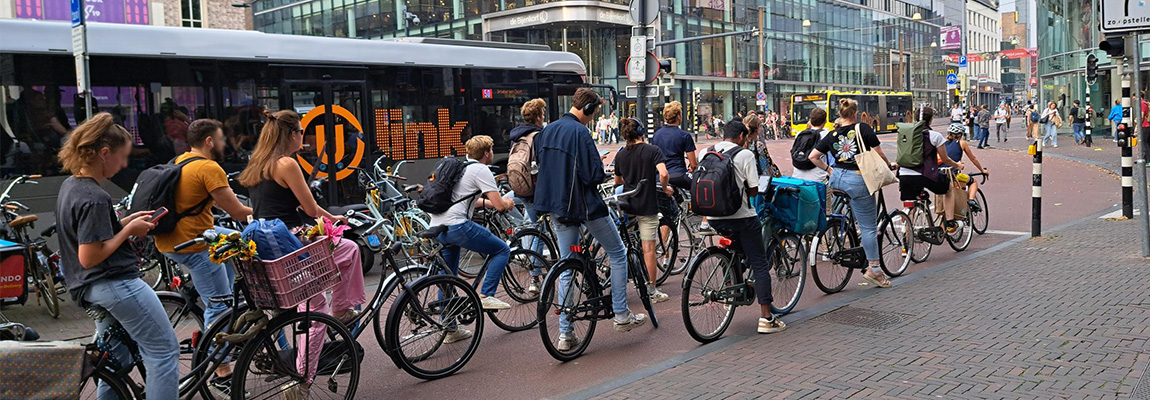
Leisure travel presents significant mobility challenges. Taken together, recreational journeys account for 39% of all trips made. In policy terms, the tourism and recreation sector and the mobility sector – both within government and in the market – still operate largely in isolation. As a result, recreational travel patterns – which are often erratic, scattered and difficult to predict – remain overlooked. However, practice shows just how closely these domains are intertwined.
Objective
By combining insights, policies and tools from both the mobility and leisure sectors, the INTERIM project contributes to effective cooperation between public authorities, businesses and travellers. With a better understanding of who is working on the same challenges, which policy documents reinforce one another, and which flows compete with one another, closer cooperation can pool resources to facilitate a sustainable mobility transition in the leisure sector. Central to this is the question of how mobility and tourism-leisure policies can be better aligned to promote sustainable accessibility.
Research questions
- Which patterns and characteristics in the current governance of mobility offer starting points for improving the integration of tourism and recreation?
- What are the characteristics of recreational travel in the Netherlands and, specifically, for different pilot regions (numbers, origin, destination, mode of transport, motivation, impact on infrastructure and the mobility network)?
- How can the combination of recreational data and accessibility data contribute to data-driven mobility planning and visitor management in pilot regions?
- What forms of collaboration between public and private parties can contribute, at local, regional and national levels, to sustainable accessibility and the early influencing of visitor behaviour within the customer journey?
Approach
The research approach within this project consists of three interrelated work packages that collectively provide insight into the governance, nature, impact and management options for tourism and recreational travel within the Netherlands, and in particular within various pilot regions. The research maps out the policy on mobility and tourism & recreation for each province, delves deeper into the barriers and potential collaborations in pilot regions, and subsequently generalises the findings back into national insights.
In Work Package 1, ‘In-depth analysis of governance of mobility and recreation & tourism’, the governance structures are analysed where tourism and mobility intersect or, conversely, fail to align. The analysis is conducted at provincial level, covering all Dutch provinces, and is explored in greater depth for the participating pilot regions. Through an analysis of existing policy documents, interviews and focus groups with stakeholders, the study examines how cooperation between the tourism and recreation sector and the mobility sector currently takes place, what bottlenecks exist – both in terms of cooperation and organisation – and where there is room for improvement. The interim report maps out the existing governance and cooperation regarding tourism and recreation mobility for each province.
In work package 2, ‘Analysis of tourism and leisure travel in the pilot regions’, tourism and leisure travel in the pilot regions is mapped out. This concerns the regions of Midden-Brabant, Schouwen-Duiveland, the Heuvelland, the Biesbosch and the Kop van Noord-Holland. Based on existing data sources, an analysis is carried out for the pilot regions of the number of tourism and leisure journeys and common points of origin and destination. In addition, Resono travel data is being purchased for each pilot region to gain a clearer picture of visitor flows. The result is an infographic/map for each pilot region that visualises the scale and nature of tourism and leisure travel, to highlight the urgency of the issue for stakeholders in the mobility and tourism and leisure sectors.
In work package 3, ‘Opportunities for collaboration’, a ‘pressure cooker’ meeting is organised for each region, combining the analysis of governance and policy with data on tourism and leisure travel. This work package translates analyses and governance insights into actionable strategies through which mobility and recreation & tourism can structurally reinforce one another. A report will be produced for each pilot region, setting out concrete opportunities for improved collaboration between the mobility and tourism-recreation sectors in that region.
Results
In addition to the results delivered in the work packages, an overall report will be produced containing policy recommendations applicable to the whole of the Netherlands, aimed at integrating tourism and recreation into mobility policy. A closing event will be organised at the end of the project. This event is intended to share the project’s results with a wide audience, including national bodies, as well as relevant stakeholders at provincial and regional level. During this closing event, potential next steps for implementation can also be explored.
Partners
- ANWB
- Visit Brabant
- Smartwayz
- Gemeente Schouwen-Duiveland
- Gemeente Texel
- Gemeente Hollands Kroon
- Gemeente Schagen
- Gemeente Drimmelen
- Gemeente Altena
- Gemeente Dordrecht
- Nationaal Park De Biesbosch
- Gemeente Vaals
- Gemeente Eijsden-Margraten
- Gemeente Valkenburg aan de Geul
- Gemeente Gulpen-Wittem
- Visit Zuid Limburg
- Breda University of Applied Sciences
- Centre for Sustainability, Tourism and Transport
- HZ University of Applied Sciences
- HZ Kenniscentrum Kusttoerisme
- HZ Lectoraat Data Science
Projectteam
Nina Nesterova (BUas)
Sjors Martens (BUas)
Maarten Soeters (HZ)
Sietske van Surksum (HZ)
Diana Korteweg Maris (HZ)
Planning
Januari 2026 – Juni 2027
Status
Ongoing.