


Why the tourism sector can no longer avoid the transition
During the CELTH Research Day, Stefan Hartman (NHL Stenden/ETFI) introduced the audience to the Sprong project ‘Hospitality Transitions’: an attempt to bring together the fragmented transition challenges in the hospitality sector into a genuine movement.
A sector with two faces
Hartman opened with a familiar dilemma. Who isn’t looking forward to their next holiday? At the same time, he put his finger on the sore spot: the further you travel, the bigger your carbon footprint. Travel generates income for destinations and enriches people personally, but that same travel causes CO₂ emissions, waste and single-use materials. According to him, this tension between economic value on the one hand and ecological damage and social tensions on the other lies at the heart of why the sector needs to transition.
The problem isn’t that we don’t realise this. Researchers, entrepreneurs and policymakers are all well aware of it. The problem is that the capacity to do something about it is fragmented and limited: too little time, too little funding, too little connection between parties that
Welcoming Transitions: a network of frontrunners
To counteract this fragmentation, Gastvrije Transities has been set up as a four-year Sprong project, with the prospect of a further four-year extension. The project combines a one-million-euro grant with a similar amount of co-funding from the sector, and connects some thirty-five organisations. Four universities of applied sciences are collaborating and are each establishing a regional transition arena, each with its own focus:
- Climate neutrality: NHL Stenden University of Applied Sciences
- Broad prosperity: Breda University of Applied Sciences
- Healthy region: HZ University of Applied Sciences
- Regenerative places: Inholland University of Applied Sciences
Hartman emphasised that the project operates on two levels simultaneously. On the one hand, the team is actively seeking frontrunners: entrepreneurs and initiatives that are already charting a different course but are getting stuck due to a lack of knowledge, networks or clout. On the other hand, the project aims to bring the right parties to the table at national level to enable systemic change.
Transition Arenas are meeting places for pioneers. Here, trailblazers come together to share knowledge, challenge the status quo, experiment and build momentum. The arenas are facilitated by the Sprong team and focus on continuous collective learning and adaptation.
The Transition Forum focuses on the national systemic level: optimising the design of the arenas themselves, sharing knowledge between the various initiatives, and accelerating learning effects that have a broad impact across the sector.
Why frontrunners get stuck
One of the most incisive observations from the presentation concerned the entrepreneurs who do want to do things differently: different revenue models, a focus on community rather than volume, and smaller-scale tourism. According to Hartman, these initiatives often have a compelling narrative, but frequently get bogged down in existing structures. Funding is hard to come by, planning permission and zoning regulations work against them, and banks are at a loss when it comes to assessing the risks of alternative forms of ownership. The dominant system, he explained, is not designed to support these trailblazers and therefore regularly holds them back.
The X-curve as a compass
To demonstrate how transition can actually work, Hartman drew on DRIFT’s well-known X-curve: a model in which an emerging movement of new experiments gradually gains momentum, whilst the existing, dominant system winds down or adapts. In this model, transition arenas are the places where these two movements intersect. There, promising experiments are identified, they receive support in setting their own agenda, a sense of urgency is created, and new coalitions are forged between parties that need one another. The ultimate aim is for experiments to scale up from start-up to established practice, whilst outdated, counterproductive ways of working are phased out.
DRIFT’s X-curve - the model that illustrates how an emerging movement gradually gains momentum whilst the old system is phased out - forms the theoretical compass of the project. In practical terms, this translates into eleven interlinked lines of action:
- Identify change-makers and frontrunners
- Set the agenda and create a sense of urgency
- Build new coalitions and networks
- Initiate and co-create experiments
- Help scale up experiments
- Strengthen connections and build organisational structures
- Challenge existing structures
- Challenge existing practices
- Challenge dominant regimes
- Change outdated practices and working methods
- Embed new practices and pathways
So it is not just about driving forward the new, but also about consciously phasing out what no longer works.
The question to the audience
The message was clear: research is not a neutral activity. Every study, every collaboration and every piece of advice contributes either to scaling up what works or to phasing out what no longer works. Gastvrije Transities aims to help researchers, entrepreneurs and policymakers make informed choices in this regard, so that acceleration does not remain merely an intention.
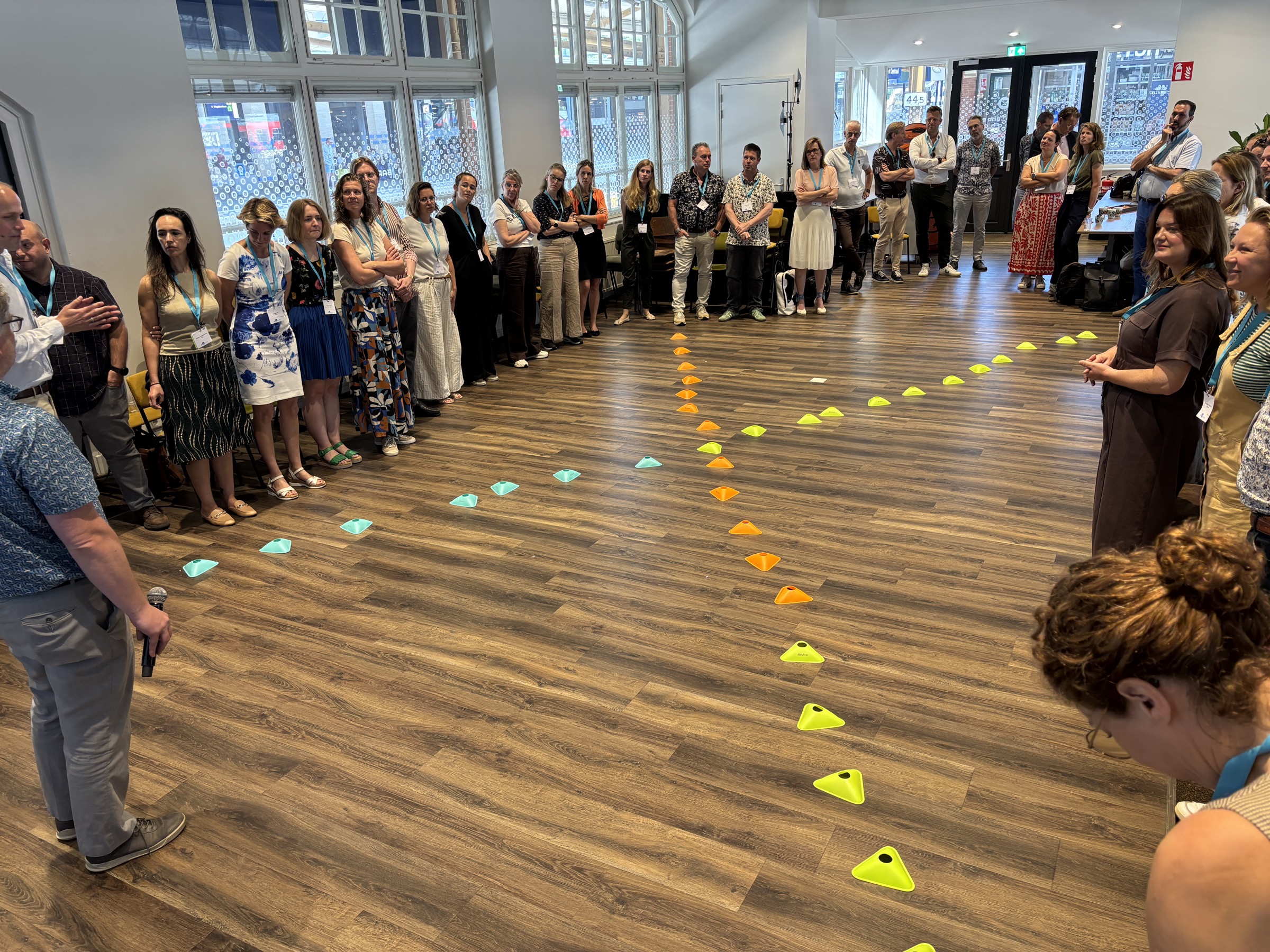
Hartman did not conclude his talk with a conclusion, but with a question for the researchers present: where does your work fit within this movement? Are you helping to scale up promising experiments, or are you unintentionally perpetuating outdated practices? They were invited to literally take their place on the X-curve based on three questions:
- Which point on the X-curve best suits your research?
- Where on the X-curve do you see the greatest challenges?
- Which point would really take the sector forward?
By having them literally visualise this question, he demonstrated what ‘Hostile Transitions’ aims to achieve: not just conducting research into transition, but also actively positioning researchers, entrepreneurs and policymakers within that transition, so that acceleration does not remain merely an intention.