

Mobilities beyond tourism: tourism in a world of unequal movement
During the Tourism 2026 Trend Conference at Saxion, a breakout session organised by the #NLTourismResearchNetwork focused on a fundamental question: how does tourism relate to other forms of mobility, such as migration and daily travel, in a world under increasing pressure from climate change and social inequality?
Session chair Prof. Dr Machiel Lamers (Wageningen University & Research) opened the session with a thought-provoking introduction. Tourist mobility is often treated in isolation in research and policy. Yet tourists, commuters, labour migrants and refugees frequently use the same infrastructure – from airports to regional train connections. Even more concerning is the fact that they are framed in completely different ways socially and politically. It is precisely by analysing these forms of mobility together that space is created for new insights and solutions.
Within Wageningen University & Research, the Centre of Expertise for Transformative Mobilities focuses on how mobility shapes our world and how it can contribute to a just and sustainable future.
“In this meeting, we step outside the familiar world of tourism,” said Lamers, who introduced the concept of mobility justice in a world of hypermobility. “Researchers from across the Netherlands demonstrate how tourism helps us understand why people travel in a world that is constantly changing.”
The paradox of hypermobility: Mobility for the privileged and restrictions for ‘the others’
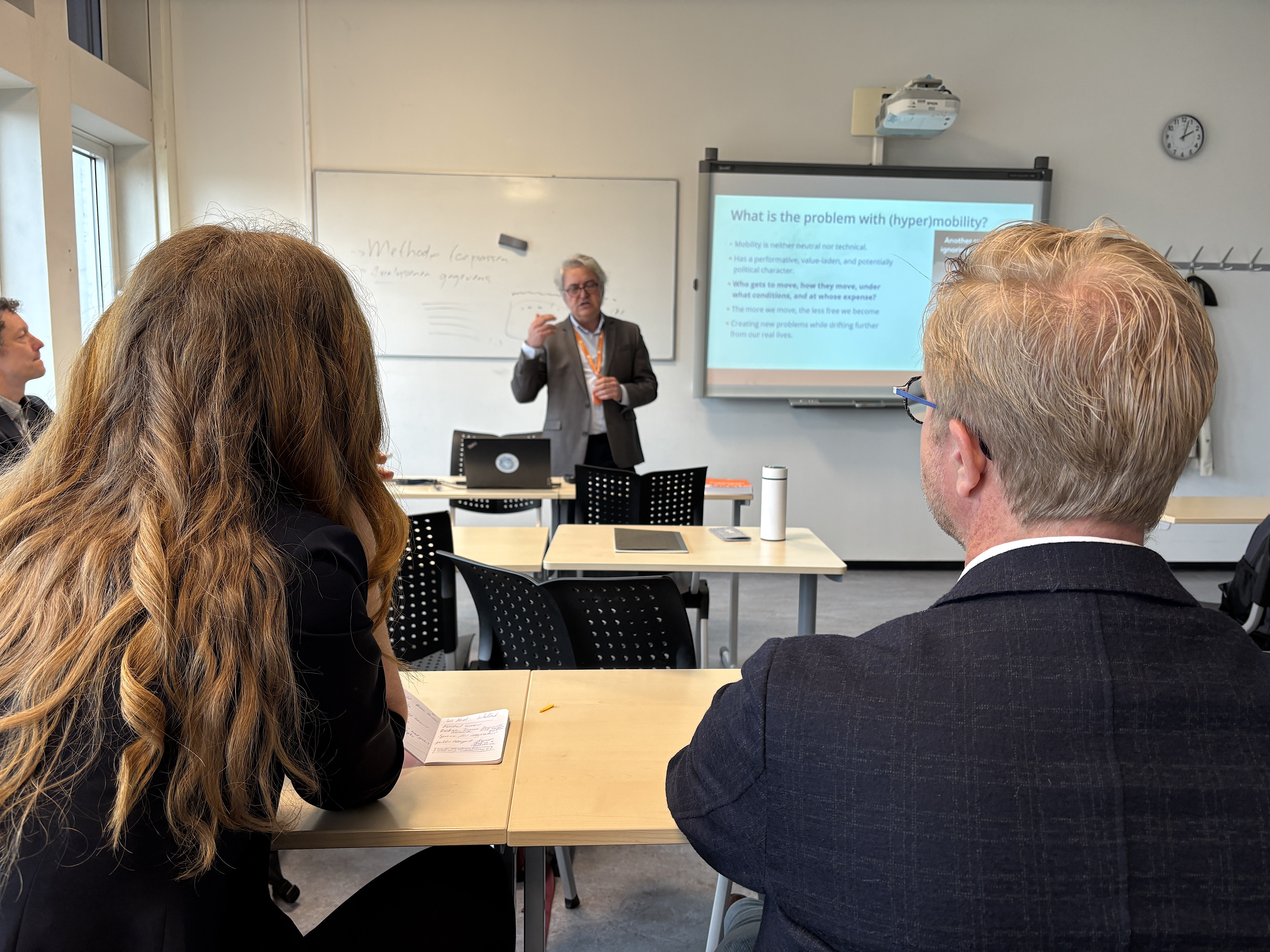
Dr Erdinç Çakmak (Breda University of Applied Sciences) presented the concept of mobility justice as a critical lens through which to understand contemporary tourist mobility. His central argument: mobility is not neutral or merely technical, but deeply political. This raises fundamental questions about who is allowed to move, how this happens, under what conditions and at whose expense. He also argued that ‘the more we move, the less free we become’ and that with hypermobility we ‘create new problems’ whereby we drift further and further away from real life.
In Çakmak’s view, tourism is one of the most visible manifestations of this hypermobility. While often celebrated as a driver of economic growth and cultural exchange, it is deeply embedded in unequal global mobility regimes and contributes significantly to CO₂ emissions. International travel is largely dominated by affluent tourists from the Global North, while mobility from the Global South is frequently restricted, controlled, or even criminalised. As Çakmak put it: “Who is allowed to travel is a political issue. Tourists from the global North are welcomed, whilst migrants from the South are scrutinised.”
These inequalities are further reinforced through what he described as mobility capital, “the resources that enable an individual to move easily with comfort. A relatively small, privileged “kinetic elite” benefits from fast, affordable, and globally connected transport systems, making mobility a taken-for-granted right.
At the same time, many others experience mobility poverty: limited access to affordable, safe and reliable transport. These groups, amongst others, often include migrants, low-income populations, women, youth, and the elderly, who not only face restricted mobility but also bear the environmental and social burdens of mobility systems. Çakmak emphasised that mobility infrastructure is not built in a neutral manner and is rarely designed for the local population. The marginalised groups are more likely to be pushed to live on the outskirts of cities, face longer journey times and bear the disproportionate burden of the severe effects of mobility infrastructure, such as noise and air pollution.
“The real question,” he argued, “ is not how we should reduce mobility, but whose mobility we are willing to confront.” Failing to integrate mobility justice into research on sustainable tourism and relying solely on technological innovation can lead to a continuing unequal distribution of mobility capital.
According to Çakmak, this holds an important warning for sustainability policy in tourism. Climate measures such as higher fuel prices or flight taxes risk exacerbating existing inequalities if they do not take into account differences in mobility capital. Technology alone – more sustainable aircraft or electric cars – will not resolve this inequality. A structural redistribution of mobility capital is necessary, with a greater focus on regional tourism, public transport and the mobility needs of local communities. In doing so, we must not prioritise reducing emissions within the current systems, but rather completely redesign these mobility systems.
His conclusion was deliberately unsettling: tourism should no longer be seen simply as a source of economic growth, but as a system deeply rooted in global inequality. The challenge ahead is not only to make tourism more sustainable but to ask ourselves the fundamental question: “Who has the right to move and who pays the price?”
Who tells the city’s story?
Whilst Çakmak focused on systems of hypermobility, Dr Meghann Ormond (Wageningen University & Research) focused on their local impact. She advocates for an inclusive city where the needs of residents and marginalised mobile groups take precedence over the convenience of the international tourist. Tourism, she argued, is not just about moving through the city, but also about who has the right to interpret and represent that city.
Ormond bases her argument on the concept that the city is a collective good, with the central question being who is allowed to decide on the design and use of public space. She argued that marginalised groups (such as migrants or people living in poverty) are often physically and symbolically erased from the urban landscape to make way for tourist consumption. There is a contrast between the ‘celebrated’ mobility of the tourist and the ‘invisible’ or distrusted mobility of the migrant. She emphasises that people who keep the city running (for example, in cleaning or the hospitality sector) often have the fewest rights to use that same city in their own way. Her presentation calls for mobility justice, shifting the focus from efficient transport to the human experience and dignity of all city users.
To challenge the dominant tourist narratives, she discussed methods such as counter-mapping: mapping the city from the perspective of residents and migrants rather than commercial interests. A fine example is the European initiative Migrantour, in which people with a migrant background jointly develop and lead interactive city walks. Instead of being the object of tourist representation, they become active narrators of urban history and contemporary life. Personal migration stories are thereby linked to broader themes such as colonial legacies, labour, heritage and urban change. “In Migrantour, people with a migrant background transform from objects of representation into active interpreters and narrators of the place, linking personal journeys to broader histories of colonialism, mobility and urban change.” In Barcelona, 100 tours are organised annually, attracting a total of 2,000 participants. In Utrecht, the figure stands at 50 tours with 600 participants per year. “These tours present the city as a layered whole of interconnected histories that challenge dominant narratives and, through personal stories and place-based experiences, encourage participants to reflect critically on identity, privilege and global–local connectedness.”
This form of responsible tourism offers opportunities for empathy, dialogue and social learning, but also involves tensions. However, the marketing of migration stories can lead to new forms of touristification, cultural commodification and even gentrification. The process of co-creation is therefore crucial: jointly negotiating what is told, how painful histories are shared and where boundaries lie. Tourism can thus become a testing ground for democratic heritage management, in line with the Faro Convention recently ratified by the Netherlands. At that conference, it was agreed that cultural heritage has, first and foremost, a social value and that people are central to how heritage is defined, managed and used. The starting point is that participation in cultural heritage is a human right, directly linked to the right to participate in cultural life. The Faro Convention states: “Cultural heritage belongs to everyone, is created by people, and must be used to build a just and inclusive society together.” Consequently, tourism is seen not only as an economic activity but also as a democratic and cultural practice where the question of who tells the story of the place is relevant.
Tourism as part of societal transitions
In the concluding discussion, a shared conclusion emerged: anyone who takes tourism seriously as a social force cannot view it in isolation from broader mobility issues. Tourism can reinforce existing inequalities, but it can also contribute to positive transitions – for example, by maintaining regional accessibility, supporting new narratives on migration, and placing the interests of residents at the centre.
The session called on researchers, policymakers and professionals to break down the tourism silo. By examining the intersections between tourism, migration and everyday mobility, we not only create a richer analytical framework but also a practical perspective for action.