

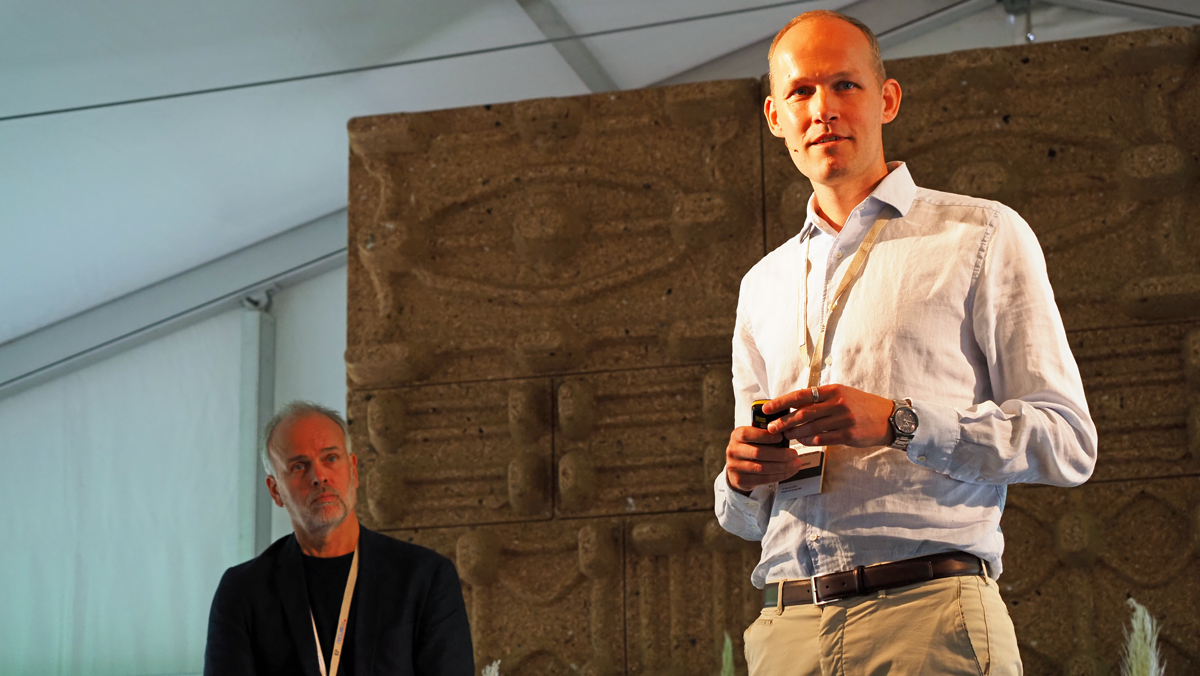
Stefan Hartman at WadNext: “What if you don’t book a holiday, but ask whether you may come?”
Stefan Hartman of the European Tourism Futures Institute (ETFI), part of NHL Stenden University of Applied Sciences, made a case at the WadNext congress on Ameland for turning the tourism debate on its head. The central question should not be how we limit the negative impacts of tourism, but how destinations, nature and communities can genuinely become better off through visitors. “Flipping the perspective”, as he called it himself.
A unique moment
Hartman opened with a compliment to the audience: the knowledge is here, and the decision-makers and policymakers are here together. In his view, now is a unique moment to take steps together and move into action mode. “We live in a complex, global context, with developments over which we have no influence but which do affect us directly.” Tourism, for instance, continues to grow worldwide, and the sector is proving remarkably resilient despite disruptions such as COVID-19 and energy crises. Research by both UN Tourism and NBTC points to considerable growth figures, including an expected increase of 10% and 2.2 million additional visitors for Friesland.
But there are limits to that growth. Hartman described the growing number of protests against tourism as ‘early warning signals’ showing that destinations are reaching their limits. At the same time, he pointed to the paradox that we are all tourists and residents ourselves: we love to travel, but as residents we are just as annoyed by the crowds. “The challenges we face are complex and call for shared responsibility”, he said, while also having to acknowledge that no one is in charge on their own. “We know what needs to happen; now it is time to act together, faster and more decisively.”
The futures triangle
To set a course, Hartman introduced the futures triangle model, which maps three forces that shape the future:
- Push factors: developments that force change, such as the growth of tourism, climate change, demographic change, pressure on the labour market, scarcity of space and changing consumer behaviour.
- Pull factors: attractive visions of the future that pull us forward: tourism in balance, broad prosperity, placemaking, meaningful experiences, quality of place and destination stewardship.
- Weight of the past: things that slow down the pace of change: policy silos, institutional structures, limited organising capacity and a lack of public support (social licence to operate).
Based on this model, Hartman outlined three possible future directions: optimising the current system, adapting the system, or a fundamental transformation of how we organise tourism.
From tourism in balance to regeneration
According to Hartman, we are currently mainly on the track of ‘tourism in balance’, focused on minimising negative impacts such as energy consumption, waste and CO2 emissions. A step further is ‘regenerative tourism’: not just limiting damage, but actually adding value to places and communities.
The most far-reaching direction goes even further: regeneration of the place itself, in which it is not tourism but the place, the people and societal challenges such as climate change and ecosystem restoration that come first. Tourism is then not an end in itself, but a means to help address those challenges.
The closing questions to the audience
At the end of his talk, Hartman challenged the audience to make ‘flipping the perspective’ concrete, with a series of thought-provoking questions:
- What if you don’t book a holiday, but ask permission to come and stay? A destination that decides for itself who is welcome, instead of admitting anyone who pays.
- What will you consume, and what will you contribute? Not only taking, but also giving: to maintenance, to nature restoration, to the place itself.
- How do we deal with coastal defence and salinisation? Do we keep fighting the sea, or do we choose to move with the water? Are we going to design the landscape in a fundamentally different way, and how do we ensure that recreation and tourism have a place in it?
- Should vulnerable nature be closed off? Or should we work with zoning or dynamic opening times? And what will tourists contribute to nature?
- How do we organise the offer other than through the traditional business model? Think of steward-owned companies, in which ownership is shared with the community rather than resting with a single owner.
- What if visitors stay longer instead of just one day? And what does that do to their bond with the area?
- What if tourism structurally helps pay for infrastructure and nature? With examples such as Bhutan (one hundred dollars per day), Palawan (the ‘pristine paradise’ environmental fee) and Greece, where a climate resilience levy is charged that increases the longer visitors stay or the more luxurious their accommodation.
Hartman linked these questions to concrete examples from elsewhere, such as the Palau initiative, in which visitors sign a pledge on arrival: a conscious choice to visit the area with respect, and private islands that select visitors on their behaviour and reward them for it.
Everyone has a role
Hartman sees a unique opportunity in Friesland and the Wadden Islands in particular to make this shift. Here, knowledge institutions, governments, entrepreneurs and communities are already closely connected. In his view, the region has everything it takes to become an international example of sustainable and regenerative destination development. Not by putting tourism at the centre, but by starting from the quality of the place, the living environment and the community.
Hartman closed with a call to all parties in the room. The sector must continue to become more sustainable, but above all take the step from sustainability measures at company level to area-wide collaboration. DMOs can further explore the shift towards regenerative tourism. In this context, he referred to the forthcoming launch of an e-book on regenerative tourism in Friesland. According to Hartman, governments need to integrate policy domains better, and fortunately they are already taking steps in that direction. It is up to everyone in the sector to keep pushing the government: “Celebrate the small successes, but keep challenging the government.” And residents must make their voices heard when things go wrong: “Protests are a necessary feedback mechanism.”
In summary
“If we can’t do it here, who can?” was his message to the audience. “By flipping the perspectives – place and people first, tourism as a means – the region can develop into one of the most sustainable destinations in Northern Europe.”
The message with which he left the audience was therefore as simple as it was challenging: don’t get stuck in discussions about tourism development alone. Make tourism an instrument for a better future for people, place and society. Because that, according to Hartman, is where the next step in destination development lies.