


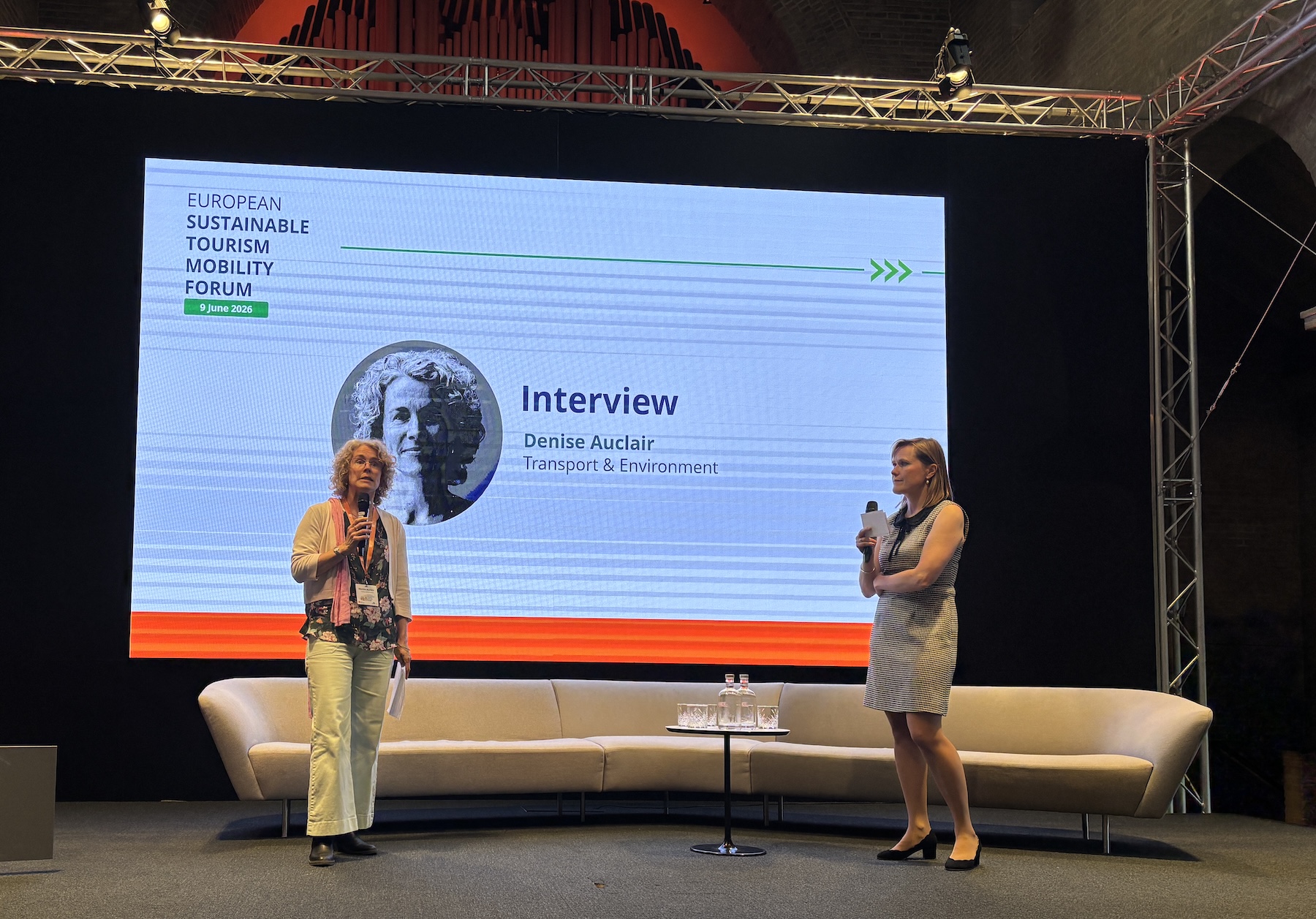
Denise Auclair - Transport & Environment: More tourism does not mean greater prosperity — it is time to make fundamental choices
At the European Sustainable Tourism Mobility Forum 2026 at Breda University of Applied Sciences, Denise Auclair, Head of the Travel Smart Campaign at Transport & Environment (T&E), sounded the alarm. Her analysis is sharp and far from reassuring: the tourism sector is still growing, but is failing to curb its climate and social impact.
“What we’re seeing is that, whilst transport emissions in Europe are beginning to stabilise, they are still rising in some sectors, such as aviation and cruises,” says Auclair. “That’s a major concern.” According to her, flying has now become “the fastest-growing source of emissions in the EU.”
Leisure flights are driving growth
The difference between business and leisure travel is striking. Whilst business flights have been declining since the COVID-19 pandemic, the opposite is true for leisure travel. “For business travel, we’re seeing a drop in the number of flights,” explains Auclair. “Companies are increasingly combining multiple destinations into a single trip or replacing meetings with digital alternatives.” But in the leisure segment, there is a catch-up effect: “In southern Europe, we see that leisure travel has increased by 10 to 20 per cent compared with 2019. The revival of tourism translates directly into more flights and therefore more emissions.”
One potential solution is for consumers to pay the true cost of an airline ticket. The big question here is whether consumers are willing to pay a higher price for their air travel, thereby putting the train or car in a stronger position. One small ray of hope is the Future-Friendly Fund. Here, travellers can see the true cost of their ticket and pay the difference between that and the price they were charged into the fund. The fund invests this money in the development of sustainable aviation.
Tourism undermines quality of life
However, the impact of tourism extends beyond the climate alone. Auclair points to new analyses by T&E and the New Economics Foundation which establish a direct link between the growth of international tourism and rising housing costs. “We see that the growth in international tourism is linked to rising rents and house prices,” she says. “In countries such as France, Spain and Portugal, these costs could rise by 150 to 250 euros a month in the coming years.” Lower-income groups are particularly affected by this. “Rising housing costs place a relatively heavier burden on lower-income households,” emphasises Auclair. In her view, tourism thus contributes to wider social inequality. Furthermore, this trend also has consequences for the economy as a whole. “Capital is shifting towards property rather than productive sectors,” she says. “This creates yet another effect: investments that would generate greater value are not being made.” According to the analysis, this could amount to more than one billion euros a year in lost productive investment in countries such as Spain and Italy.
Low wages, low productivity
Another structural problem highlighted by Auclair is the quality of work in the tourism sector. Despite growth, wages are lagging behind. “In countries with high levels of international tourism, we often see low or stagnant wages in the hospitality sector,” she says. “In Ireland, for example, wages are around a third of the national average; in Greece, around half.” According to her, this points to an economic model that relies heavily on volume rather than value. “That is not the sort of development you would expect or want. It shows that growth in tourism does not automatically lead to widespread prosperity.”
Fewer international arrivals
Auclair’s conclusion is therefore that fundamental choices are needed. One of her most outspoken recommendations is to curb the growth of international tourism. “In regions where tourism is reaching saturation point, it is sensible not to allow international arrivals to grow any further,” she argues. “That can help to reduce pressure on housing and quality of life.” She acknowledges that this is a sensitive issue in a sector that is strongly growth-oriented, but calls it inevitable. “If we continue down the same path, the risks will only increase. ”
More rail, more local travel
As an alternative, Auclair advocates a shift in mobility and tourism patterns. “We need to focus more on regional and domestic travel,” she says. “And, above all, on lower-emission transport, such as rail and – where appropriate – efficient road transport.” Such a shift could not only reduce emissions but also contribute to a more balanced geographical distribution of tourism. “Air travel often leads to concentration in a limited number of hotspots,” she explains. “Other modes of transport can help to distribute tourism more evenly.”
Fair prices and a better distribution of wealth
Finally, Auclair emphasises that the economic model of tourism needs to be overhauled. That means: higher wages, higher productivity and a fairer distribution of revenue. “We need to look at how we can increase wages and productivity in the hospitality sector,” she says. “And how the value generated by tourism can be channelled more effectively to local and smaller businesses, rather than mainly to large international players.” According to her, this requires active policy and targeted decisions. “It’s not just about how much tourism we have, but also about how the benefits and burdens are distributed.”
Fundamental reorientation
The core of Auclair’s message is clear: sustainable tourism cannot be achieved through technological solutions or efficiency gains alone. “We need to better understand the real impact of growth in tourism,” she concludes. “And, based on that, make choices that benefit the climate, the economy and society alike.” In doing so, she poses a fundamental question to the sector: not only how tourism can become greener, but also whether it is still sustainable in its current form.