


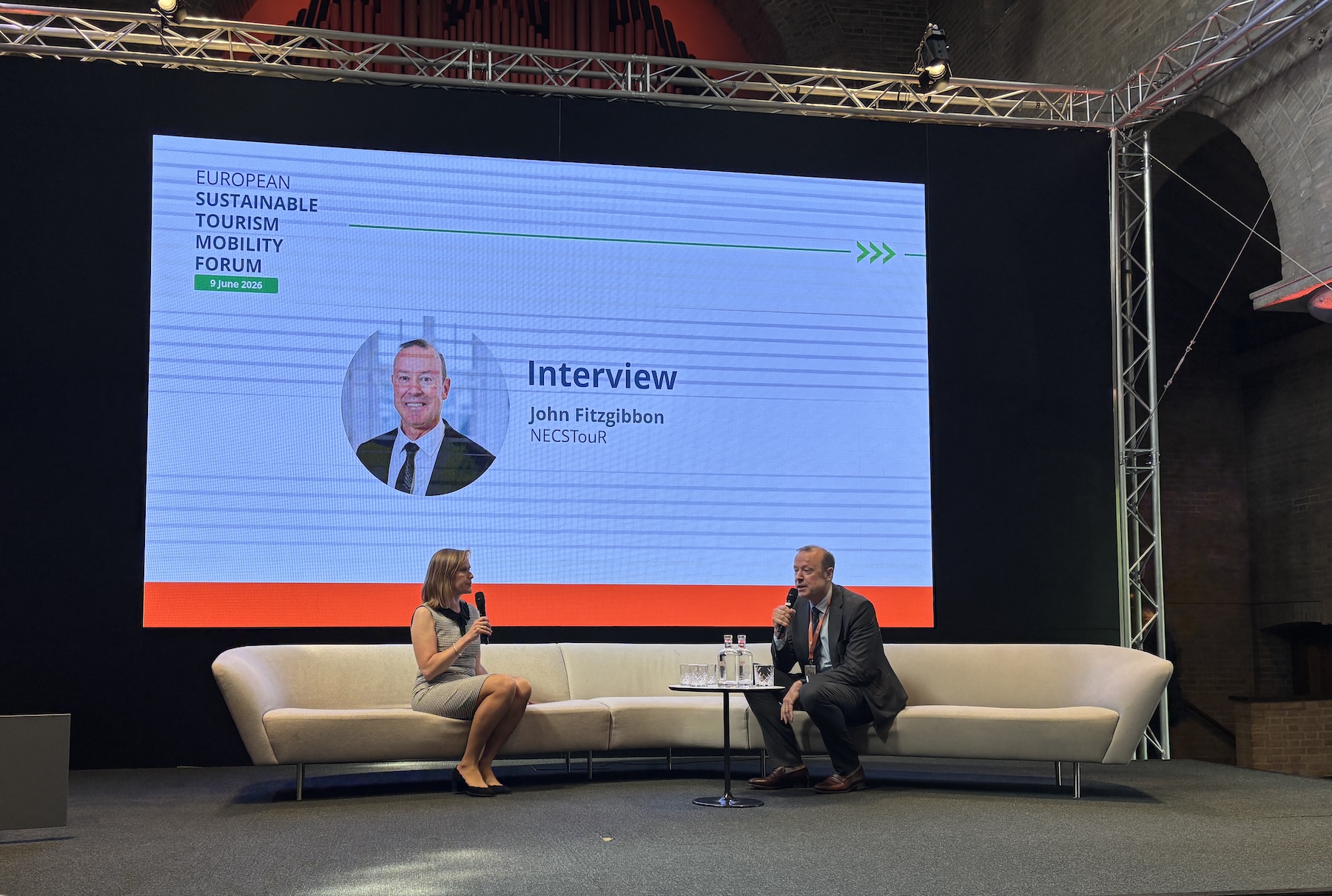
John Fitzgibbon NECSTouR: Without sustainable mobility, there is no future for tourism
At the European Sustainable Tourism Mobility Forum 2026, the same message was echoed from various quarters: mobility and tourism are inextricably linked. In an interview, John Fitzgibbon, Managing Director of NECSTouR (Network of European Regions for Competitive and Sustainable Tourism), highlighted a distinct regional dimension to this. His analysis: tourism is a success story, but that is precisely why a fundamental shift is necessary.
A sector that has become too successful
Fitzgibbon begins with what appears to be a positive observation. “Tourism is a huge economic force. It accounts for around 10 per cent of employment and 10 per cent of GDP,” he emphasises. “It really is a success story.” But, he argues, the problem also lies within that very growth. “The challenges we see today, such as overtourism in cities, are in fact symptoms of that success.” In doing so, he puts the current discussions into perspective: it is not a question of failed policy, but of a sector that has reached its own limits. According to Fitzgibbon, this calls for a different approach to governance. “If we continue to promote Europe as we do now, marketing alone will not be enough. We need much more support in the area of governance.”
Marketing alone is not enough
He makes this point explicitly: the traditional role of tourism organisations – promotion and marketing – is no longer sufficient. “Marketing for the sake of marketing is not enough,” says Fitzgibbon. “We need to back that up with much stronger governance.” By this he means steering, regulation and strategic choices at regional level.
Mobility as the foundation of tourism
The crux of his argument is clear: without mobility, there is no tourism – and without sustainable mobility, there is no sustainable tourism. “It is impossible to make the tourism system climate-neutral without a sensible strategy for sustainable mobility,” argues Fitzgibbon. “The dilemma is that there is simply no tourism without mobility.” He therefore praises the European Commission’s decision to combine transport and tourism into a single portfolio. “That makes perfect sense. The two belong together.”
Nevertheless, in practice he still sees too much separation between the two sectors. “What we really need is for tourism specialists and transport specialists to work together. We cannot afford to continue working in silos.”
Regions as the key to change
NECSTouR represents European regions and sees them as the key to change. Fitzgibbon emphasises that regional knowledge is essential for effective policy. “Destination management organisations have evolved enormously,” he explains. “They no longer focus solely on promotion, but also on issues such as the environment, support for SMEs and cultural heritage.” According to him, this broad role makes them crucial to the mobility transition. “The knowledge and expertise available in the regions is indispensable when designing sustainable mobility strategies.” He advocates for that knowledge to be systematically integrated into transport policy. “Only in this way can we make destinations future-proof – not just for today, but also in the long term.”
From vision to implementation
NECSTouR itself is actively seeking to shape this integration. Fitzgibbon explains how his network is working on a joint strategy for 2030. “Together with our regions, we have developed a transition pathway,” he says. “Sustainable mobility is central to this, even if it is not always explicitly mentioned – it is woven into everything we do.” He outlines various components of this approach:
- Governance: cooperation and policy coordination between regions
- Destination development: spreading tourism and sustainable infrastructure
- Conscious marketing policy: steering towards desired forms of tourism
- Economic transition: with a focus on decarbonisation
- Data and innovation: via the Tourism of Tomorrow Lab
“Sustainable mobility plays a key role in all these areas,” says Fitzgibbon.
Learning from one another
An important aspect of NECSTouR is knowledge-sharing between regions. “The strength of our network lies in collaboration,” he says. “Regions learn from one another, exchange experiences and develop solutions together.” In his view, this is essential in a complex and fragmented policy field. “Tourism touches on so many different areas – from the economy to the environment and mobility – that no single region can tackle it alone.”
Europe must remain a frontrunner
Despite all the challenges, Fitzgibbon remains optimistic about Europe’s position. “There is no reason why Europe cannot remain the world’s leading tourist destination,” he says. But that does require adaptation. “We must ensure that our destinations are resilient and future-proof. That means: better governance, better cooperation and, above all, a strong focus on sustainable mobility.”
Conclusion: integration is key
Fitzgibbon’s message ties in seamlessly with the broader discussions at the forum, but adds an important perspective: that of the regions. His core message can be summarised simply:
- Tourism is economically crucial, but it has its limits
- Marketing alone is not enough
- Mobility is the key to sustainability
- Regions must be at the heart of the solution
Or, as he himself puts it so forcefully: “You cannot make tourism sustainable without mobility. And you cannot organise mobility effectively without the knowledge of the regions.” In doing so, he makes it clear that the future of tourism does not lie solely in Brussels or with transport operators, but must instead take shape at regional level.