

The Right to Travel Must Be Balanced with the Right to Live
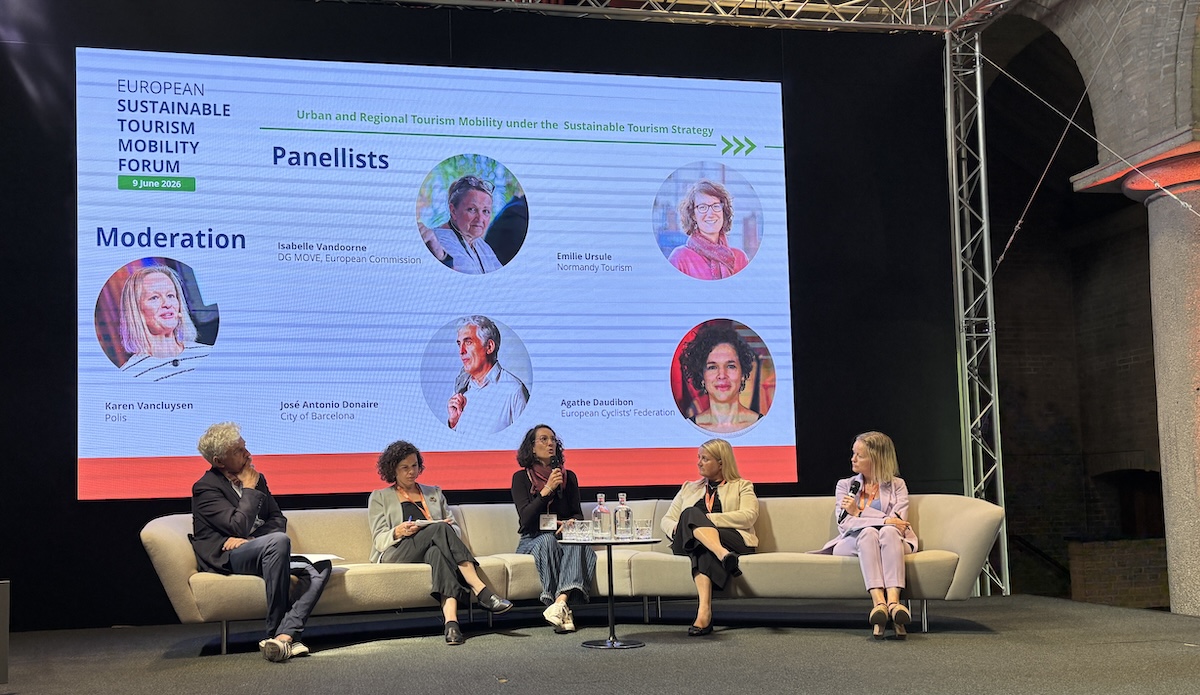
During the closing panel of the European Sustainable Tourism Mobility Forum 2026, the discussion became concrete and at times urgent. Moderated by Karen Vancluysen (Polis), European policymakers, cities, regions, and stakeholder organizations addressed one of the most challenging questions: how do you organize tourist mobility in a way that keeps cities livable? The central theme: tourism and mobility have been developed separately for too long, and this is now causing friction.
From Promotion to Management
Moderator Vancluysen immediately set a sharp tone. “Tourism places enormous pressure on transport systems in cities and regions,” she stated. “But it can also be a catalyst for change—improving public transport, redesigning public space, and accelerating sustainable mobility.” According to her, this requires a fundamental shift: “We need integrated strategies in which tourism and mobility are addressed together, rather than in separate silos.”
This perspective was strongly reinforced by José Antonio Donaire, responsible for sustainable tourism in Barcelona. His city has become an international symbol of the downsides of tourism growth. “Our focus is no longer on attracting more visitors, but on managing the impact on the city and daily life.”
No More Growth, Better Distribution
According to Donaire, Barcelona has already taken firm measures. “In 2017, we froze the capacity for tourist accommodation. No additional beds are being added,” he explained. “And by 2028, all licenses for tourist apartments will be phased out.” But this has proven insufficient. “The number of overnight stays is stabilizing, but day-trippers and cruise passengers continue to grow,” he warned. “We receive 15 million tourists annually, including 4 million cruise passengers and 7 million day visitors.”
This makes mobility a crucial steering instrument. “Transport is not only a means of bringing people into the city,” Donaire emphasized. “It is primarily a tool for better distributing visitors and reducing pressure.” A concrete example is the Zona Bus 4.0 system. “Coach operators must register, pay, and submit their routes in advance,” he said. “An algorithm determines when and where they are allowed to stop. This allows us to actively regulate pressure.” His conclusion was clear: “It’s no longer about how many tourists we attract, but how we coexist with the tourists who are here.”
European Strategy: Integration and Ease of Use
From the European Commission, Isabelle Vandoorne (DG MOVE) confirmed that these insights are being incorporated into the new European strategy. “The core is integration,” she said. “We must include tourism in urban mobility planning, rather than treat it as a separate topic.” According to her, this means concrete improvements for travelers:
- Better physical access to destinations
- Clearer information, for example about access rules in cities
- Easier ticketing across different modes of transport
“A tourist should be able to move around easily using sustainable transport options,” Vandoorne stated. “This requires better information and user-friendly systems.” At the same time, she tempered expectations regarding strict EU regulations. “We must respect subsidiarity. Cities have their own competences,” she said. “But we can support them with tools and, above all, incentives.” Notably, she expressed a preference for soft measures. “We see that nudges and incentives are often more effective than restrictions.”
Incentives Work: Examples from Normandy
This approach was illustrated by Emilie Ursule of Normandie Tourisme. Her region shows that cooperation between mobility and tourism works—provided it is well organized. “Five years ago, we started bringing the two sectors together,” she explained. “Simply by having people sit down together and discuss their challenges.”
This quickly led to concrete projects, such as a dedicated bus line for the D-Day commemorations. “That line has improved every year and now operates structurally during the summer,” Ursule said. “Its success comes from genuine collaboration and linking visitor needs to mobility solutions.” The region has also developed a notable incentive program. “We offer a ‘low-carbon fare’: discounts at more than 140 attractions for visitors who arrive by train, bus, or bicycle,” she explained. “The number of participants and users is growing each year.” According to Ursule, this is key: “Information and incentives are crucial. People are more likely to choose sustainable options when they are both easy and attractive.”
Cycling as a Connecting Factor
Cycling also played a prominent role in the debate. Agathe Daudibon (European Cyclists’ Federation) made it clear that cycle tourism is anything but niche. “Cycling is one of the best forms of transport,” she stated. “And with 24% of Europeans cycling weekly, the potential is enormous.”
According to her, the strength lies in the dual role of cycling. “The same infrastructure can serve both tourists and everyday users,” she explained. “On the Danube cycle route, one third of usage comes from local cyclists.” And the reverse is also true. “In the Netherlands, cycling highways are heavily used for recreation on weekends,” she said. “Mobility and tourism reinforce each other.”
That is why she advocates an integrated approach. “See cycling both as a fully-fledged mode of transport and as a tourism activity,” Daudibon concluded. “It helps to distribute tourism better while offering sustainable mobility.”
The Tourist as a ‘Temporary Resident’
An important concept endorsed by several panel members is the idea of treating tourists as ‘temporary residents.’ “We should approach tourists in the same way as residents,” Vandoorne argued. “If we organize mobility well for residents, visitors will automatically benefit.” This requires a different way of planning, where urban, regional, and national mobility systems are better aligned for both residents and tourists.
Conflicting Rights?
At the end of the debate, Donaire brought the discussion back to its core. “The right to travel freely within Europe is important,” he said. “But it must be balanced with the right of residents to continue living in their own city.” According to him, this tension is real. “Sometimes the presence of visitors conflicts with the lives of residents,” he stated. “We need to be honest about that.”
The climate impact cannot be ignored either. “Tourists generate three million tons of CO₂ in Barcelona,” he noted. “But transport to the city causes as much as nine million tons annually. Moreover, they use significantly more energy and water per capita.” This made it painfully clear how large the challenge is.
Conclusion: Cities in the Driving Seat
The closing panel made it clear that the future of sustainable tourism depends not only on technology or infrastructure, but above all on choices:
- Cities must actively manage visitor flows
- Europe must support with strategy, data, and resources
- Regions must cooperate across sectors
- And travelers must be encouraged to make more sustainable choices
Or, as Vancluysen summarized: tourism can only become sustainable if mobility is fully integrated. And as Donaire sharply concluded: “The right to travel freely within the European Union must be compatible with the right to live in your own city.”