

Beyond the Numbers: BUas Students Explore Climate Risks in Montenegro from the Inside
Living, working, and spending four weeks in a place you do not know, surrounded by people you have never met: for second-year students of the Bachelor of Science Tourism, this has long been the essence of the International Field Project (IFP). This year, the group conducted its field research in Montenegro, linked to the CELTH project Destination RiskScan, which maps climate risks for tourism destinations around the world. Harald Buijtendijk, lecturer and researcher at Breda University of Applied Sciences (BUas), reflects on the approach, the encounters, and why he prefers not to reduce everything to a traffic-light colour.
From Southeast Asia to the Balkans
The International Field Project is a mandatory component of the Bachelor of Science Tourism, the joint degree programme offered by BUas and Wageningen University & Research. Worth 12 ECTS credits, the course focuses on conducting independent research in a destination whose culture, history, political context, and economy differ significantly from those of Western Europe.
Prior to the COVID-19 pandemic, BUas traditionally organised the project in Southeast Asia.
“I do not want to take anything away from that,” says Buijtendijk, “but many students already have considerable travel experience nowadays. It was becoming a case of: I've already been to Bali. At the same time, it became increasingly difficult to reconcile such long-haul travel with a programme in which sustainability plays an ever-growing role.”
When international travel resumed after the pandemic, the programme team decided to rethink the format. The assignment they received from students was clear: create a cross-cultural learning experience closer to home and without flying. Through professional contacts, Buijtendijk connected with a local tour operator in Montenegro. Since then, four successive cohorts of students have conducted field research in the country.
Montenegro has proven particularly suitable. It is a small, mountainous country with remarkable geographical diversity.
“You can find virtually every landscape type imaginable there, all within a relatively small area,” says Buijtendijk.
Coastal destinations, an urban capital, rural regions, and mountain villages are all located within a few hours of each other. These correspond directly to the four destination types distinguished within Destination RiskScan, making them ideal for comparison.
Four Regions, Four Perspectives
The second-year students divided themselves across four regions, each with its own relationship to tourism and climate:
- Coast – Bar and Ulcinj
- City – Podgorica
- Mountains – Kolašin
- Rural Areas – Andrijevica, Plav and Gusinje
Each team of four to six students arranged its own accommodation and established its first local contacts independently. Twice a week, two lecturers visited each group for an hour to discuss progress.
“They decide where we meet them. They know the place; we do not,” says Buijtendijk.
Once in the field, students are responsible for carrying out their own projects, based on a research plan prepared in advance.
According to Buijtendijk, this fundamentally distinguishes the project from a conventional study trip or excursion.
“It is not a matter of going somewhere, listening to presentations, conducting a survey, visiting three hotels and writing a short report. That is not what this is. That is why we explicitly call it fieldwork and field research.”
Numbers Need Context
The connection with CELTH’s Destination RiskScan project provided the fieldwork with a clear research question.
The project has identified approximately 45 quantitative indicators capable of mapping the climate risk profile of tourism destinations worldwide.
“That all sounds fantastic,” says Buijtendijk, “but in the end they are all numerical scores.”
The students therefore focused on a different question:
“How do people in the destination itself perceive climate risks? What matters to them in their daily lives, not only for themselves but also for their children? And what does that mean for their work in tourism?”
This qualitative perspective provides an important complement to an otherwise strongly quantitative project and simultaneously offers students a clear assignment.
Buijtendijk is critical of reducing complex realities to a single score or colour-coded ranking.
“I am very aware of the limitations of capturing complex realities in a few numbers. I think it is great that we can eventually produce a traffic-light map showing which destinations face high, medium, or low climate risks. But what complex realities lie behind those colours? How do people experience climate change? Those are the questions our students explored.”
Stories That Stay With You
For Buijtendijk, the true value of the course lies not merely in achieving learning outcomes related to intercultural relations or research methodology, important as those may be within an academic programme.
“What we are really asking them to do is this: go somewhere you do not understand at all, talk to people you have never met, make friends, build relationships, and explain to us how that place became what it is today, socially and in terms of tourism, in an academically sound way.”
One story has stayed with him in particular.
“Oh, you're from the Netherlands? Then you bombed me. My neighbour was killed in that war. But that was then; now we are friends. Come, let's have a rakija.”
Buijtendijk uses this anecdote to illustrate how fieldwork extends beyond the research topic itself.
“These stories often have nothing to do with the research subject. But at the same time, they have everything to do with it. And they stay with you forever. As a lecturer, I find that far more important than simply ticking a project box.”
He recalls a similar experience during earlier fieldwork in Myanmar. Students asked local residents about “the government” and were met with a question in return: Do you mean the rebels or the central government?
“That is when students learn the difference between a ceasefire and peace. And tourism runs right through those realities.”
Melting Winters and Rising Temperatures
In terms of content, students observed several climate-related changes in Montenegro, particularly shifts in seasonal patterns.
The country traditionally had a winter sports season, but declining snowfall is putting winter tourism under pressure.
“If they want to keep that industry going, discussions are already taking place, just as in the Alps, about artificial snow. The question is whether that is really wise.”
At the same time, the distinction between seasons is becoming increasingly blurred.
“One day it is still the winter season, and the next day you can start the summer season.”
Along the coast, concerns focus more on water shortages and water quality. In Podgorica, meanwhile, temperatures rise rapidly because of the city’s location in a basin surrounded by mountains.
“If you are unlucky, it can already reach 40 degrees Celsius in May. We experienced that last year. Fortunately, conditions were much better this year.”
According to Buijtendijk, the city’s design contributes to the problem.
“It also heats up quickly because it appears to have been built more for cold conditions than for extreme heat.”
Presenting Initial Findings to the Minister
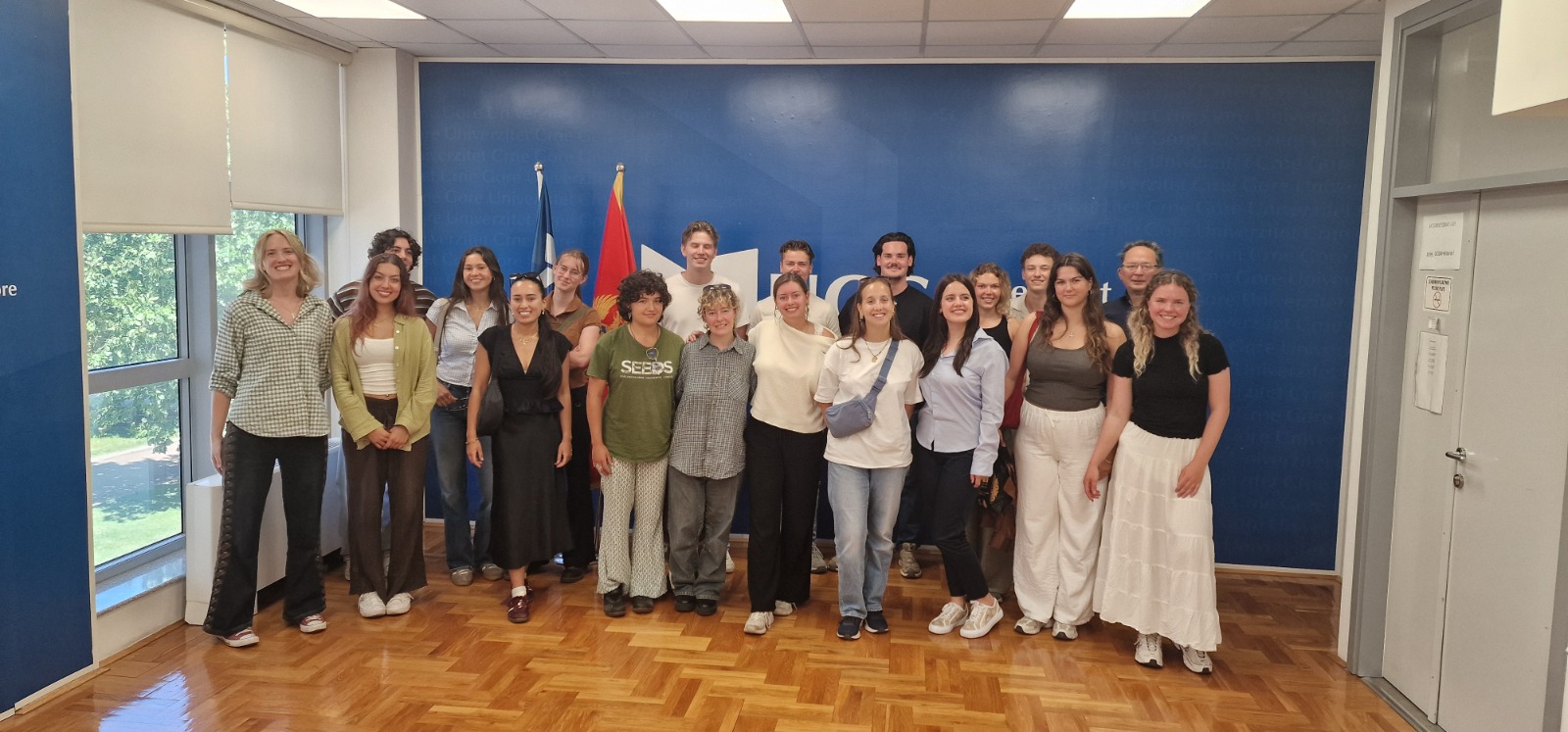
One of the most memorable moments of the programme was the presentation of preliminary findings at Montenegro’s Ministry of Tourism. Students had the opportunity to share their early insights directly with policymakers, including Minister of Tourism Simonida Kordić.
For Buijtendijk, this marked an important difference from previous editions of the course. Rather than working for a single local client, the students were contributing directly to the Destination RiskScan project.
“That is why I was very pleased that Anke Arts, Director of CELTH, was able to visit as well, and that together we could meet with the Minister of Tourism to present our interim findings. It was a great experience for the students.”
The University of Montenegro was also represented, through Vice Dean Ilija Morić of the Faculty of Tourism, with whom BUas collaborates through the BSc Tourism programme under Erasmus+.
A Model for the Future?
Within the BSc Tourism programme, this qualitative fieldwork model already holds a permanent place in the curriculum.
For CELTH, Buijtendijk also sees opportunities to embed this approach more firmly within future research projects, provided two conditions are met: academic depth must be maintained, and there must be a meaningful connection with education that extends beyond a mandatory thesis assignment.
“In that case, you could include these longer, exploratory, quasi-ethnographic studies as part of the assessment criteria for specific themes. Not every topic is equally suited to this approach, but there are plenty of people, including at our partner institutions, who are open to it and have the necessary expertise.”
This aligns with a broader ambition that is becoming increasingly important within CELTH: not only producing reports, but creating real-world impact.
During the conversation, Buijtendijk compares a statistic such as sea levels are rising by two centimetres per year with the personal story of someone who can no longer moor a small boat because the quay is regularly flooded.
Stories like these, he argues, simply resonate more strongly and provide the human dimension that numbers alone cannot capture.
About Destination RiskScan
Destination RiskScan is an initiative of CELTH aimed at helping tourism destinations worldwide understand and manage climate risks. The project combines three layers of analysis:
- Local exposure: the overlap between climate hazards (such as heat, storms, and wildfires) and tourism assets, including beaches, hotels, and infrastructure.
- National context: broader resilience factors such as economic stability, governance, and dependency on tourism.
- Sector resilience: the tourism sector’s capacity to adapt through diversification, innovation, and stakeholder capabilities.
By combining geospatial data, national indicators, and qualitative insights, the project is developing an open-source methodology and interactive dashboard that will enable destinations to identify vulnerabilities and prioritise action.
For Montenegro, where tourism accounts for approximately 30% of GDP, the research comes at an important moment. The country is currently working on a new long-term tourism strategy focused on sustainability, diversification, and resilience.
With thanks to Harald Buijtendijk for the interview, and to Anke Arts (CELTH) for providing additional background information on the visit to Montenegro.