


Hospitality sector at a turning point: people-centred employment practices crucial for the future
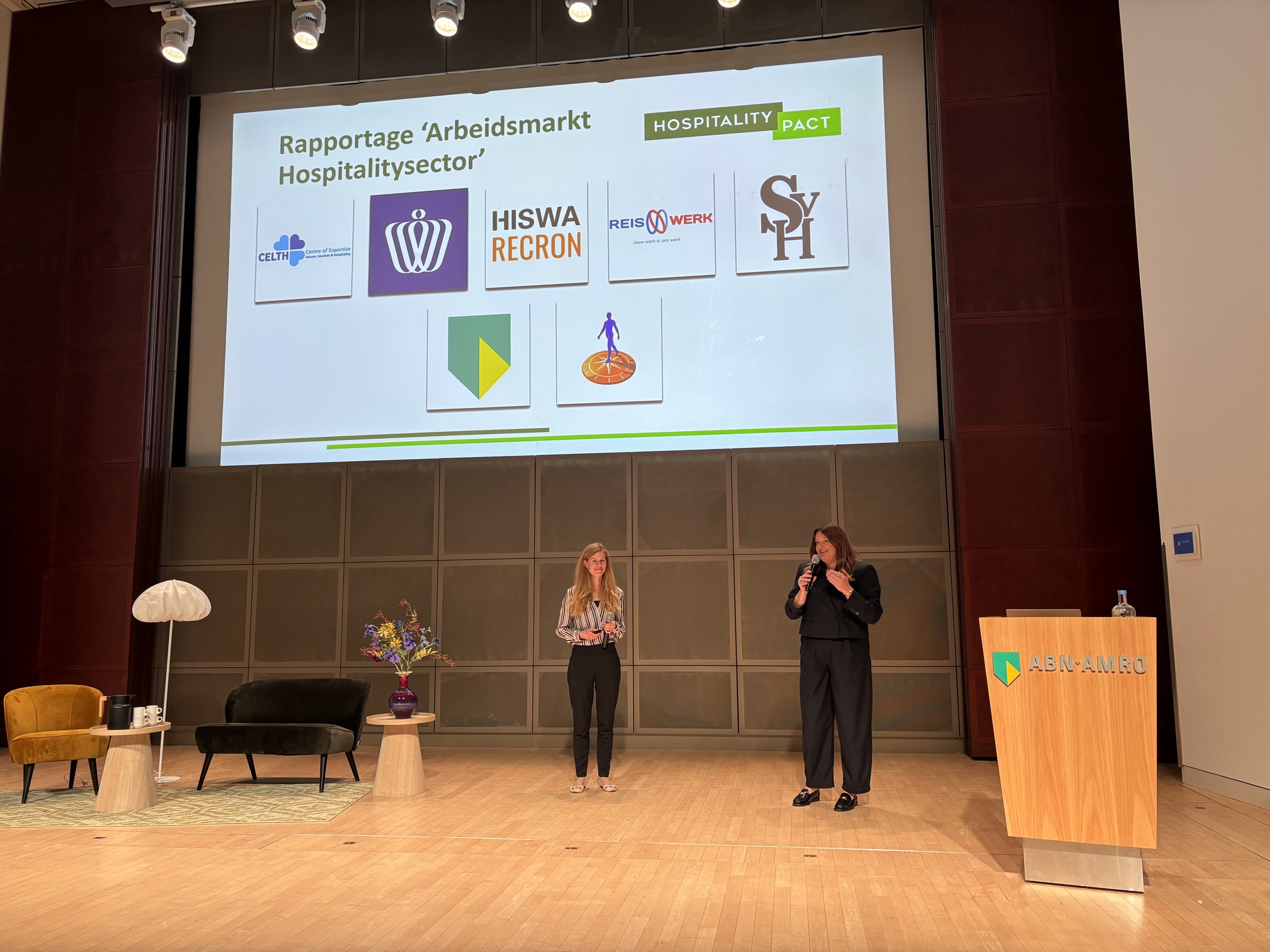
The Dutch hospitality sector is at a turning point. This is evident from the new report ‘Labour Market in the Hospitality Sector – Monitor, Trends & Best Practices” by CELTH and partners, presented at the annual meeting of the Hospitality Pact.
The combination of current labour market data and practical insights shows that the sector is not only recovering from the coronavirus pandemic, but must also undergo fundamental change to remain future proof. “We see that staff shortages are not cyclical but structural,” says researcher Lobke Elbers, who also observes that digitalisation is changing the nature of work and that employees are approaching the job market differently: “They are looking for meaningful work, opportunities for personal development and want to be heard.”
Demand for staff remains high, supply lags behind
With around 722,000 workers in 2024 – 26% more than in 2015 – the sector is back on a growth trajectory following the pandemic, but that growth is clearly levelling off. Nevertheless, this does not mean the challenges in the labour market for the sector are over. As researcher Marloes de Vries succinctly put it during the presentation: “Demand for staff remains high, whilst supply is under pressure.” This is due, on the one hand, to a declining number of young people in society and, on the other, to increasing replacement demand due to an ageing population.
This tension is further exacerbated by a decline in the number of graduates entering the sector and increasing competition from other sectors. At the same time, the hospitality sector has traditionally experienced high staff turnover, with around a quarter of employees leaving the sector each year. According to Lobke Elbers, this calls for a different way of thinking: she believes the sector is “not only under pressure, but at a tipping point”, where staff shortages, digitalisation and changing employee expectations converge. The central question has therefore shifted: it is no longer a question of whether the sector must change, but how.
Employees value flexibility and the working atmosphere
What emerges clearly from the analysis is that the hospitality sector remains strong in its people-oriented character. Employees value the flexibility, the working atmosphere and the focus on the human aspect of work. At the same time, key conditions are lagging behind, such as terms of employment and development opportunities. For instance, only around a third of employees undertake training or a course, significantly fewer than in the wider labour market. This combination of a strong culture and fragile conditions means that the sector is both attractive and vulnerable. Precisely for this reason, the research suggests that the key lies in future-oriented employment practices.
The analysis of best practices shows that an increasing number of organisations in the sector are already making this shift. A number of clear trends are emerging. Hospitality is shifting from a focus on efficiency to a focus on people, with technology playing a supporting rather than a leading role. As Elbers aptly put it: “People who want to work with others don’t want to be mere cogs in a system; they want to make a difference through human interaction.”
Perspective on working in hospitality is shifting
This also shifts the perspective on work itself. Organisations need to think less in terms of fixed roles and more in terms of skills. Alongside professional knowledge, it is precisely communication and empathy skills that are becoming decisive. The sector is thus developing increasingly towards what Elbers calls a ‘high empathy sector’: an environment in which technology takes over routine work, but the value of work shifts towards what makes people unique: attention, interpretation and empathy.
- From roles to skills: skills such as communication and empathy are becoming just as important as technical knowledge.
- High tech and high empathy: technology provides support, but human contact remains central.
- From employer branding to everyday culture: employees stay because of what they experience on the work floor every day, not because of campaigns.
- From HR tool to leadership: sustainable employability is becoming the responsibility of managers, not just the HR department.
- From salary to purpose: meaningful work is becoming an increasingly important binding factor.
The labour market in flux
Another key insight concerns employee retention. Organisations appear to benefit not so much from strong employer branding campaigns, but from day-to-day practice. Employees stay when they feel seen, heard and valued. “Culture is not determined by what you say, but by what employees feel and experience on a daily basis, and by sharing that with others.” Culture is therefore no longer a ‘soft’ issue, but, according to Elbers, a strategic factor in the survival of organisations.
Leadership is crucial
Leadership also plays a crucial role in this. In practice, sustainable employability does not work as a standalone HR tool, but only when it is part of managers’ day-to-day actions. Elbers: “It’s about the real conversation: how are you doing, where is the pressure, what are your real needs and what can I do to support you?”
Finally, a sense of purpose is becoming increasingly important. In a sector where workload and pay can be under pressure, meaningful work appears to be a key unifying factor. Employees are not just choosing a job, but an environment in which they can develop, be themselves and contribute to something greater than their role alone.
These insights make it clear that the sector’s transition is more profound than is often thought. It is not about isolated improvement measures, but about a fundamental reorientation of how work is organised, and what good employment practices and good leadership mean. Elbers: “This means that the sector is not changing step by step, but fundamentally. Moreover, the future of the sector is not determined solely by technology or investment. But above all by the choices organisations make today in how they treat people.”
Actions for business owners
For business owners in the hospitality sector, there is a clear challenge. The insights from the research translate into a number of concrete actions:
- Invest systematically in development: make learning and career progression visible and accessible to all staff
- Strengthen the daily work culture: ensure that values such as care, trust and collaboration are tangible on the work floor
- Actively focus on leadership: support managers in having meaningful conversations and guiding staff
- Look beyond job titles: organise work around skills and talents rather than fixed roles
- Use technology thoughtfully: deploy technology to support employees, not to replace human contact
- Foster a sense of purpose: demonstrate what the organisation stands for and how employees contribute to it
- Improve employment conditions where possible: whilst ensuring the organisation remains competitive in a tight labour market
The conclusion is clear: organisations that succeed in adopting a people-centred approach are better able to attract, develop and retain staff. As a result, future-oriented employment practices become not just an ideal, but a necessary condition for the success of the hospitality sector.
The comple report (in Dutch) Arbeidsmarkt Hospitalitysector – Monitor, Trends & Best Practices is available for download.