


Adventure begins where certainty ends: frontrunners on regenerative tourism
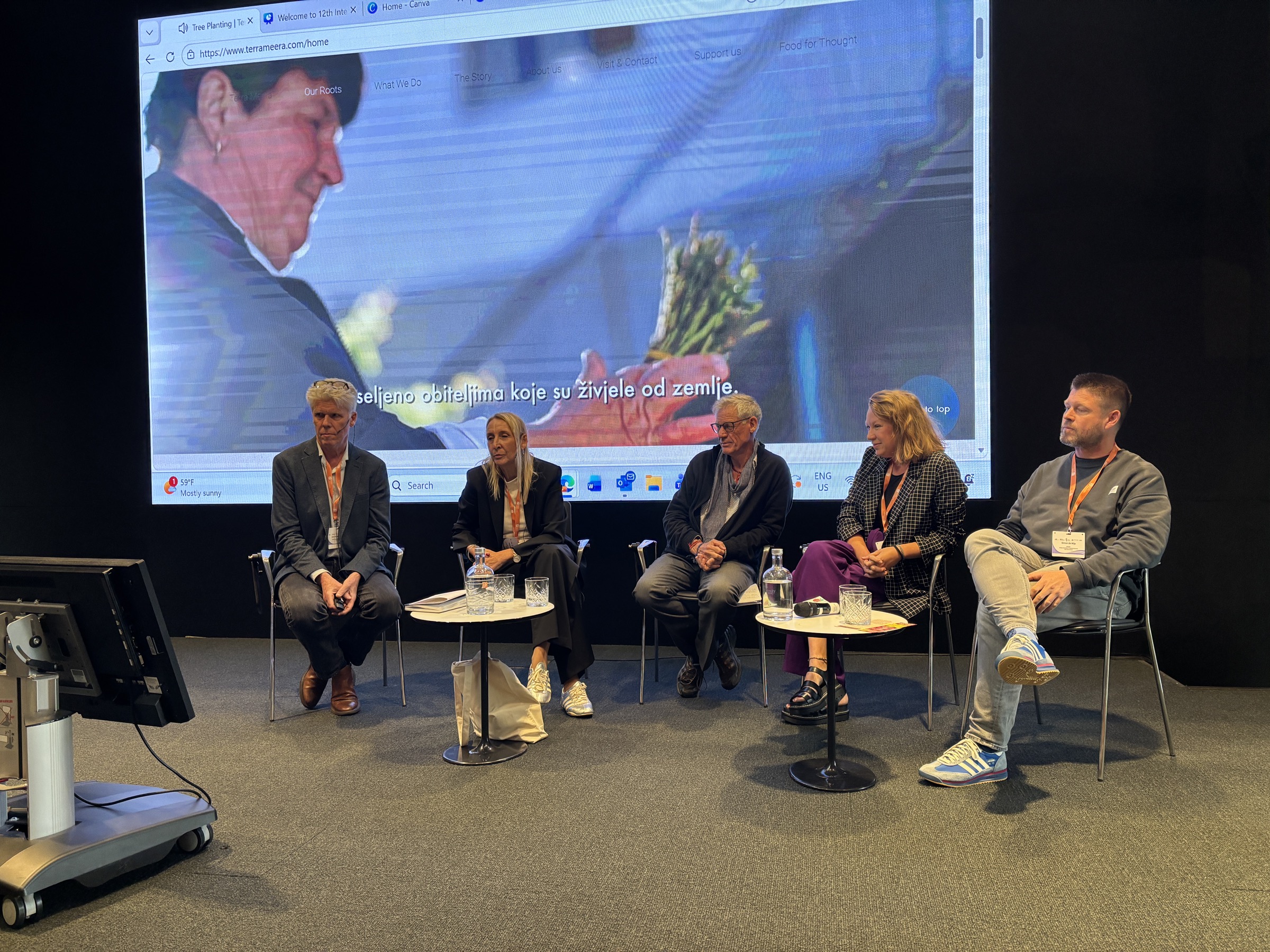
During a CELTH industry panel on the International Adventure Conference 2026, four frontrunners from the leisure, tourism, and hospitality sector – active in Amsterdam, Brabant, Croatia, and Nepal – discussed what regenerative tourism means in practice. Moderator Jos van der Sterren guided the conversation through four themes: guest engagement, financial sustainability, trust and collaboration, and the step toward systemic change.
Report from the CELTH Industry Panel – "Transforming Leisure, Tourism and Hospitality (LTH) Ecosystems: Experiences from LTH Frontrunners," moderated by Jos van der Sterren (CEO CELTH, BUAS), with Simon de Wijs (SPRONG), Anouschka Trauschke (Tours That Matter), Irena Ateljećvić (Terra Mera & Regenerate Europe), and John Hummel (Okharbot Organic Farm, Nepal). The panel was part of the International Adventure Conference 2026 by the Adventure Travel Tourism Research Association (ATRA) held at the Breda University.
Adventure begins where certainty ends
Anouschka Trauschke of Tours That Matter opened with a personal note on the theme of adventure. She shared that she initially wondered whether she was the right person to speak about adventure, until she realized that, as she put it, adventure begins where certainty ends – a feeling she recognized from her own step into entrepreneurship seven years ago.
Tours That Matter emerged after a period during which Trauschke worked on a biodynamic farm in Portugal, where she came to realize that her place was actually in Amsterdam. Together with two former tour guides, she started in Amsterdam's Red Light District, a neighborhood that at the time was stuck in regulations, complaints, and policy pressure. Rather than developing new tours, the team started by listening – to residents, formerly homeless people, bar staff, and guides. This gave rise to storytelling circles, events, and eventually tours across seven different Amsterdam neighborhoods over a period of seven years. Trauschke stressed that the ultimate goal is not the experience itself, but the encounters that result from it – encounters that genuinely change how people relate to their surroundings.
Terra Mera: back to the forgotten trees
Irena Ateljećvić (Terra Mera and Regenerate Europe) showed a short film about her project in an abandoned Croatian valley, once rich in fruit trees and lively village communities but emptied out by war and mass tourism elsewhere in the country. In the film, she described her return to this place to find the forgotten trees of her childhood and to preserve local knowledge of traditional varieties before it disappears.
Terra Mera focuses on regenerating both land and community: planting a native fruit forest, organizing workshops, and working together. Everything comes together in the bistro, where visitors can taste traditional dishes.
SPRONG: regions as testing grounds for transition
Simon de Wijs, transition manager at SPRONG Hospitable Transitions, outlined how the leisure, tourism, and hospitality sector can drive broader societal change. The SPRONG project, a collaboration between four universities of applied sciences (including BUAS, Hogeschool Zeeland, and NHL Stenden), works according to a three-step method.
The first step is identifying frontrunners, pioneers, and changemakers – people testing new systems who sometimes "fail forward" in order to move ahead. The second step is setting up local or regional transition arenas. De Wijs himself works in Brabant on the plant-based transition and on nature-inclusive, hospitable farms – farms of the future where agriculture, recreation, care, and nature come together. The third step is feeding the lessons learned from these frontrunners back into policy, in collaboration with organizations such as CELTH and the National Council for Tourism and Recreation.
Okharbot Organic Farm: from "practicing what you preach" to "preaching what you practice"
John Hummel introduced Okharbot Organic Farm in Nepal, which he set up nine years ago together with his partner Monique as a direct foreign investment on three hectares of land. He described himself as not a researcher and not a farmer, but more of a development worker, drawing on his background with a Dutch development organization.
The farm combines a vegetarian lodge, built using local rammed-earth architecture, with regenerative agriculture. According to Hummel, food production in Nepal is at least as important as tourism, simply because food is needed. The farm now employs seven people and increasingly hosts Nepalese farmer groups who want to learn about organic agriculture.
Financially, after nine years the farm has just reached break-even. Hummel emphasized the importance of self-sufficiency – with its own water, energy, and wastewater treatment – and warned other farmers against taking out loans, explaining that doing so quickly turns farming into contract farming and causes the loss of the entire regenerative energy. He and Monique financed the start themselves, partly using savings from the time of the euro crisis, supplemented by consultancy work. About 60% of income now comes from the lodge.
Engaging guests: beyond the metrics
Asked how to genuinely engage guests and how to measure whether an experience changes anything, Trauschke responded critically to the concept of "regenerative tourism" itself, saying she strongly believes it is really about changing the way people look at a place or at each other. She illustrated this with a card she received from Hong Kong students after a tour through Amsterdam-Noord, in which they wrote that their encounters with residents reminded them of their own reality in Hong Kong and inspired them to reflect on their own lives.
Trauschke said that for years she tried to meet B Corp-style sustainability metrics, but that doing so takes a lot of time that could otherwise be spent creating actual impact – time spent proving what you do rather than doing it.
Ateljećvić agreed and argued for a different kind of language around impact, saying it all revolves around metrics and quantifying impact. She advocated bringing in a more feminine perspective on change – humanizing the work being done – referring to research on "the world of man and the planet of woman" and the problem that a small number of (often male) billionaires don't know how to share wealth.
Asked whether the focus on "moral ambition" – a reference to Rutger Bregman, who according to the moderator mainly appeals to an elite group – isn't itself elitist, Ateljećvić replied that it is about holding the tension between opposites: some changemakers focus on systemic power and international structures, others on community level. As long as the underlying intention aligns, the approach shouldn't be judged.
Multiple functions, multiple revenue streams
De Wijs emphasized that many pioneers in Brabant naturally already combine multiple functions – food, agriculture, tourism, recreation, care – but that financing rarely matches this. He gave the example of a vegetable subscription from a regenerative farm, where people can pick up vegetables for 25 to 30 euros a week, combined with a shop where tourists can get a drink – something that in practice often runs into permitting and zoning issues.
Building trust and finding the right ecosystem
A question from the audience about how to involve the right people – politicians, entrepreneurs, policymakers – led to one of the most layered discussions of the panel. Ateljećvić described years spent building trust in a region of Croatia where residents had repeatedly been disappointed by EU projects and government promises that were never fulfilled.
She now sees more young, entrepreneurial people returning to the countryside. She mentioned a regenerative farmer in Dalmatia – a landscape architect who earns between 40,000 and 60,000 euros a year using regenerative methods by supplying top-quality products to restaurants in Split. Such success stories help reduce skepticism among other farmers, since seeing successful examples makes others want to join in.
Trauschke added that in her work, the relationship with governments and politicians is difficult because they speak a different language. She works from local experiments in specific neighborhoods, while policymakers think from a national or municipal perspective. It works better with politicians who themselves work bottom-up with communities. But even then, explaining the value of tourism remains a hurdle. Her key insight was that you can't talk about tourism before you've tried to restore the ecosystem that tourism is supposed to support. In areas where the local ecosystem – social, economic, and ecological – is already broken, tourism adds no value and the money doesn't end up anywhere useful. Where the ecosystem is still intact, tourism can actually be supportive.
John Hummel, drawing on his experience in Nepal and Asia, stressed that trust is built mainly through concrete, visible results – things you can show, prove, talk about, and make tangible.
Trauschke sees Tours That Matter more as "a connector" than a tour operator: building relationships with parties that have access to other audiences, so that experiences also reach beyond the "green elite" – a dilemma she recognized in other frontrunners such as Groene Afslag, who sometimes end up in a "change school" that only reaches like-minded people.
De Wijs added that many pioneers deliberately start small and local, are transparent about what they do, and gradually grow their community – often driven mainly by community itself, more than by tourism as such. Trauschke illustrated the gap between supply and demand with an anecdote: after an appearance on the American TV network CBS, she received hundreds of requests the very next day from American travelers looking for this kind of alternative experience – while river cruise operators had previously claimed their guests had no interest in this. According to her, this reflects a real misconception within the sector about what consumers actually want.
From local experiment to systemic change
The final part of the conversation focused on the step from small-scale, local initiatives to broader systemic change. De Wijs was critical of classic scaling-up ("can we get more McDonald's or Red Bulls?") and instead argued that farms and places with multiple functions could grow into stewards of broader wellbeing at the regional or local level. He referred to the concept of the 15-minute city, asking what adventure can be found within five kilometers of home. He called for not wasting attention on people who would rather fly to Barcelona for a weekend anyway, and instead facilitating the groups that are open to change, letting places function as guardians of biodiversity and cultural heritage.
Hummel built on this with his vision of tourism as part of a living system. In his view, regenerative tourism is therefore not a separate concept, but simply tourism within a regenerative living system. At the same time, he made clear that Okharbot deliberately stays small: the business doesn't want to grow beyond its three hectares of land and keeps to a single lodge of eventually eight rooms (16 to 20 beds). The farm has no booking system and works only through direct contacts and trusted tour operators – always making personal contact with people first – and is even vegetarian without advertising this on the menu. Growth happens mainly through education and research: moving from practicing what you preach to preaching what you practice.
Ateljećvić closed the panel with the most fundamental call. In her view, individual agency is not enough: the system that commodifies everything and benefits only a few needs to be stopped. She argued that regenerative tourism cannot emerge within a "degenerative paradigm," and called for a new discourse: no longer "tourism" as a separate, commercial domain, but "hospitality," returning to the quality of the relationship between host and guest. In her ideal world, countries would have no separate Ministry of Tourism, but one integrated ministry of "Agriculture, Hospitality and Ecology." Her closing words summarized the core of the panel: first, residents themselves should value the quality of life and their own environment, and from there, invite guests to share in that experience.