


Sustainable tourism requires a fundamental shift in mobility
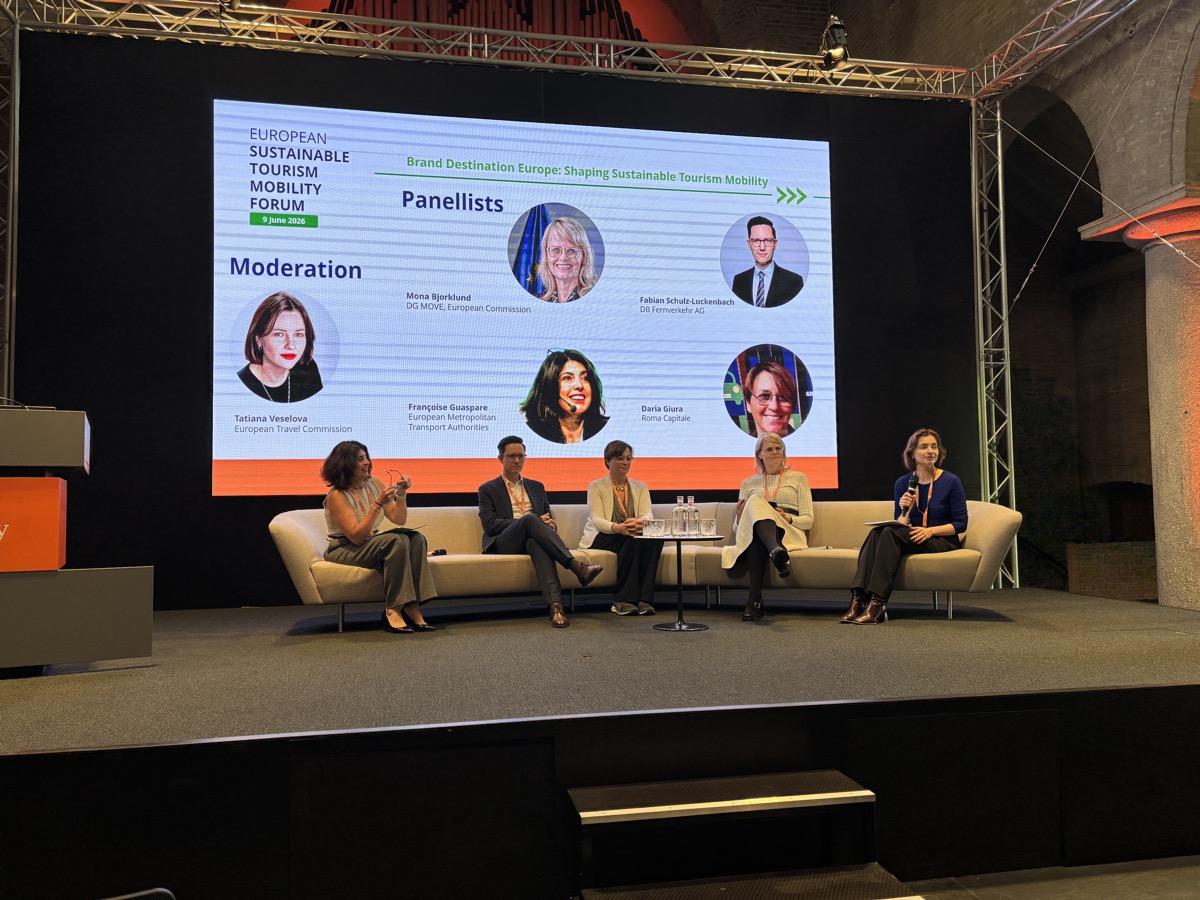
During the European Sustainable Tourism Mobility Forum 2026 at Breda University of Applied Sciences, one question took center stage: how can Europe maintain its position as a top destination without mobility undermining sustainability? A wide-ranging panel led by Tatiana Veselova (European Travel Commission) laid bare both the tensions and the opportunities.
Not just growth anymore, but impact
Moderator Veselova set the tone immediately by challenging the sector's dominant narrative. A successful European destination, she argued, is no longer just about growing visitor numbers, but about impact, better distribution of visitors, and travelers who leave a positive footprint. Mobility, she said, is the crucial factor: not just how tourists arrive in Europe, but how they move around the continent afterward, and whether attractive, sustainable alternatives to flying are on offer.
Europe wants to keep its leading position
Mona Bjorklund (DG MOVE, European Commission) emphasized that Europe wants to hold on to its leading position as a tourism destination, remaining the world's top destination for international travelers. But that needs to be achieved differently going forward. According to Bjorklund, the travel experience itself is part of the "Brand Europe" — not just the destination, but also the journey there and mobility within Europe are integral to its appeal, and tourism needs to be both sustainable and seamless.
The solution, Bjorklund suggested, lies in a more balanced system. It isn't about pitting modes of transport against each other: aviation remains essential for long distances, but for short and medium trips, rail should become the obvious choice.
Rail is gaining ground — but the system is straining
Fabian Schulz-Luckenbach of Deutsche Bahn confirmed there's real potential for that shift. The modal shift is already underway, he said, pointing to a record 25 million international rail passengers last year — almost 30% more than before the pandemic. Demand, he noted, exceeds supply: interest in rail travel across Europe is enormous, larger than what can currently be offered. As an example, he mentioned that on the Paris-Stuttgart route — under three and a half hours by train — there are no longer any commercial flights, since travelers simply prefer the more attractive train option.
Still, major obstacles remain. Schulz-Luckenbach pointed to "the three I's": infrastructure, interoperability, and intermodal equality. High-speed infrastructure is missing in many places; trains can't run across Europe without modifications due to differing national systems; and price differences are heavily shaped by regulation, often favoring aviation. As an illustration, he noted that adapting a single train type to run in multiple countries can cost around €200 million in extra modifications — costs that ultimately have to be recouped through ticket prices.
Cities under pressure from tourist flows
From a city perspective, Daria Giura (City of Rome) painted an urgent picture of overtourism and mobility pressure. Tourism is the city's most important sector, she said, but Rome also needs to protect its identity. Concentration of visitors is a major problem: ninety percent of tourists stay in the city center, while only five percent visit other parts of the city.
According to Giura, mobility management is essential. Rome doesn't want to ban tour buses, but to regulate them — they should park outside the center, with tourists continuing by metro or train, reducing pressure on the city. Regulation and digitalization play a key role, she stressed, calling for more European coordination and smarter systems to manage tourist flows.
Public transport as the backbone
Françoise Guaspare (European Metropolitan Transport Authorities) made clear that urban and regional transport is the linchpin of sustainable tourism: if mobility isn't sustainable, tourism never will be either. The biggest challenge, in her view, lies in coordination — tourists don't care about administrative borders, but policy remains highly fragmented. Tourism also needs to become a recognized, integral part of a city or region's mobility policy.
She called for a much stronger role for urban transport authorities, connecting long-distance mobility with local networks through multimodal hubs that serve not just as transport nodes but as gateways to the city. These hubs need major improvements — better stations, cycling facilities, and travel information — but without European investment in the "last mile," billions invested in rail lose their effect. Ticketing is another pain point: needing a different app in every city is absurd, she said, when travelers want simple, intuitive journeys. The solution: an integrated European ticketing system providing access everywhere.
Governance, data, and investment
Guaspare highlighted three structural challenges: a lack of integration between tourism and mobility; insufficient coordination between stakeholders; and a structural shortage of investment and data. Without data, tourist flows can't be managed effectively, she warned — and this is where Europe can make a difference, by developing standards and platforms.
Toward a new mobility model
The throughline of the debate: the current way of organizing travel and tourism isn't sustainable, but clear solutions exist. According to Bjorklund, the European Commission is working on concrete measures, including investment in high-speed rail lines, improved booking systems, and tools such as an emissions label for flights to help travelers make better choices. But panelists agreed infrastructure alone isn't enough — it's also about choices, price incentives, and behavioral change. As Veselova summarized it, the future of tourism in Europe depends on the willingness to fundamentally reform mobility — not just making it more sustainable, but smarter and more attractive too.
Conclusion: systemic change needed
The panel made clear that the key to sustainable tourism isn't a single solution, but a coherent systemic transformation: less dependence on aviation within Europe, a major expansion of rail, better urban mobility, and above all, much stronger cooperation. As Guaspare put it, mobility should no longer be seen as a precondition for tourism, but as a core part of it — and that is precisely where Europe's biggest challenge lies.