

Keynote ENTER26: Many steps still to be taken for data-driven tourism
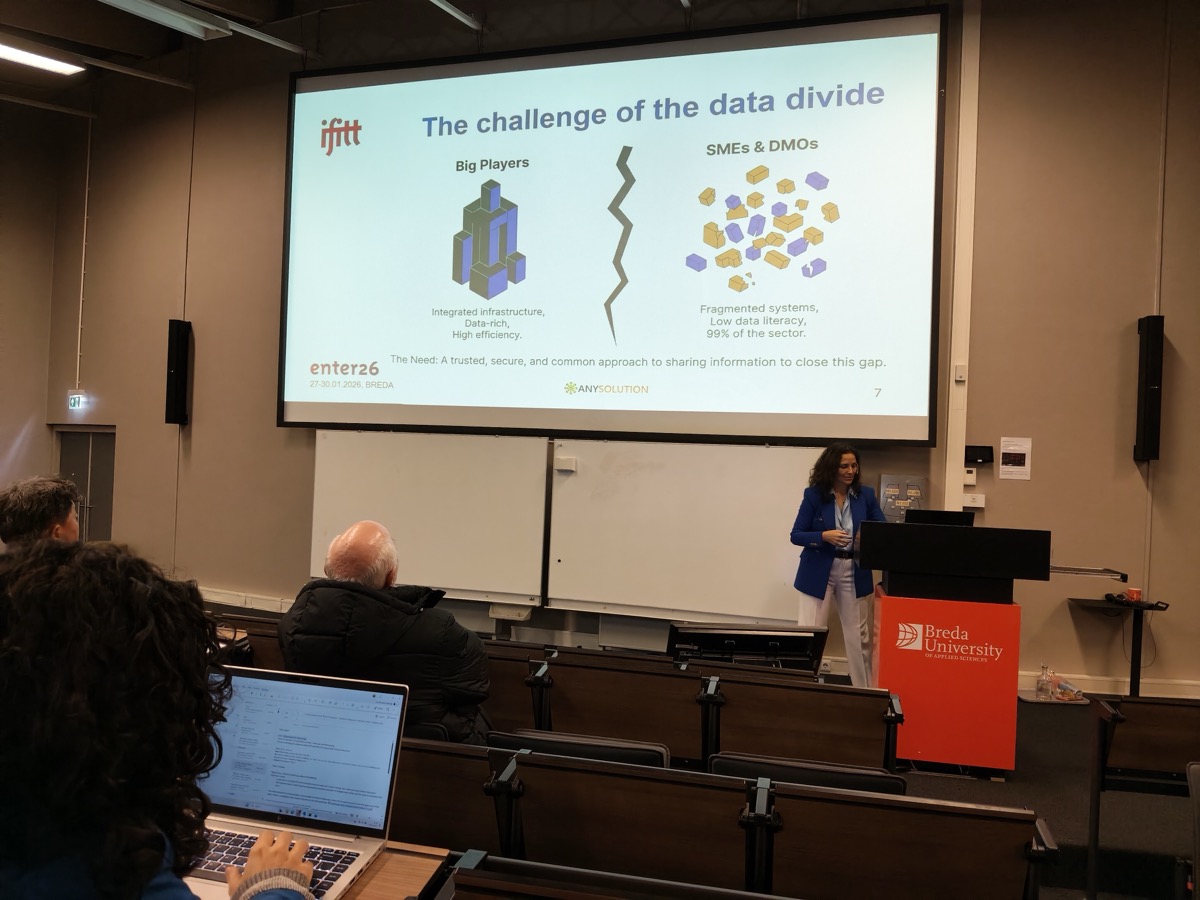
During the ENTER26 conference at Breda University of Applied Sciences, Dr. Dolores Ordóñez presented a compelling vision of the digital and sustainable transformation that European tourism will undergo in the coming years. As a researcher and entrepreneur (Any Solutions), she plays a central role in various EU projects related to data spaces, destination management, and tourism innovation. Her keynote made one thing crystal clear: tourism is at a tipping point. The sector has more data than ever before, but still lacks the structure, skills, and governance to use this data effectively.
Her story focused on four key themes: Twin Transition, Data Paradox, Global Shifts, and Core Challenges.
Twin Transition: sustainability and digitization as a twin movement
Although tourism was expected to change fundamentally after the COVID pandemic, the reality turned out to be different. Demand did not decline; on the contrary. That is why the European Commission sees the Twin Transition (green and digital) as the cornerstone of a future-proof sector. According to Ordóñez, tourist destinations can only become truly sustainable when they can measure their ecological and social impact with data. However, many destinations still struggle with poor data quality, insufficient standardization, and excessive geographical aggregation. Meanwhile, problems such as water shortages, waste streams, and mobility pressure are felt at the local level. The digital transition is also lagging behind: AI applications are being used, but often based on incomplete or inconsistent datasets. Ordóñez emphasizes that AI is only as good as the data on which it is trained. Initiatives such as DeployTour with the new European Tourism Data Space aim to bridge this gap. In this system, data is not stored centrally but shared via catalogs of datasets, with ownership and privacy guaranteed.
The Data Paradox: abundance, but little usability
One of the most provocative concepts from the keynote was the Data Paradox. This consists of both a technical and a social paradox. “Everyone claims to have enormous amounts of data, until you start looking at exactly what data this is, who owns it, and in what format it exists,” said Ordóñez. She sees destinations that have been collecting information for years without uniform methods. This makes benchmarking with other destinations practically impossible. In addition, much of the data is available at an aggregated (often high) level, which obscures the local reality of tourism.
Furthermore, many organizations lack the skills to extract value from data. Even destinations and companies with terabytes of information are often unable to make any strategic decisions based on their data sources. Ordóñez: “We are drowning in the amount of data but cannot extract any insight from it.”
Added to this is a social paradox. Citizens do not want to share their data with governments for better public services. But they give away personal data en masse to social platforms such as TikTok, Meta, and LinkedIn. That data is then unavailable to small market players who account for the vast majority of the tourism product. This presents an enormous challenge: how do you build trust between citizens, businesses, and governments, especially in a sector that is heavily dependent on personal data for personalization but also has to comply with GDPR?
Global Shifts: new travelers, new patterns, new risks
Ordóñez also outlined a world in which tourism is undergoing radical change. Three global shifts stand out:
- Post-pandemic growth and changing behavior
Contrary to predictions, the global desire to travel is stronger than ever. Travelers are looking for experiences, sustainability, hyper-personalization, and work-vacation hybrids (“workations”). - Climate change as a structural factor
Destinations are facing drought, heat, storm damage, and pressure on ecosystems. Without data-driven monitoring and targets, there is a lack of control over these developments. - The concentration of power of global platforms
Many AI and data services come from large American technology companies. European data and tourist information are thus stored outside Europe, while the EU is simultaneously working on digital sovereignty.
These shifts increase the need for European alternatives such as the Common European Data Spaces (14 domains, including tourism).
Core Challenges: fragmentation, flows, skills, and governance
From the two EU-wide surveys of more than 200 destinations, Ordóñez distilled four core challenges for the tourism of the future:
- Balance between residents and visitors
Tourist flows put pressure on livability, affordability, and urban amenities. - Climate adaptation
Destinations must be able to measure and predict climate risks, from water management to energy consumption. - Redistribution of tourists in space and time
Overcrowded hotspots arise because everyone uses the same ‘top 10 lists’; intelligent routing and real-time information can counteract this. - Support for emerging destinations
Many regions want to grow, but risk repeating the mistakes of established destinations.
In addition, she identified three challenges related to data:
- Fragmentation of data between sectors (mobility, environment, agriculture) and levels of government (local, regional, national, EU).
- Lack of data skills among DMOs and especially among the 95–98% of small businesses that dominate the sector.
- Lack of standardization, which limits comparability and interoperability.
Recommendations from Dr. Ordóñez
Five concrete recommendations can be derived from her keynote speech:
- Harmonize data collection at the European level
With templates, indicators, and shared definitions, destinations can finally generate comparable data. - Invest in data skills at DMOs and SMEs
Capacity building is essential to turn data into action, for example through Facilitate and other training programs. - Develop governance for data spaces
Ownership, contracts, metadata catalogs, and transparent access are crucial for trust and collaboration. - Work towards real-time, local data
Granularity (level of detail) is key to managing peak crowds, monitoring sustainable KPIs, and testing policy measures. - Involve citizens in data policy
Only by creating social legitimacy can destinations collect the data needed to balance livability and tourism.
Conclusion
Dr. Dolore Ordóñez's keynote speech made it clear that tourism is facing a fundamental transformation in 2026. The combination of digital innovation, sustainable transition, new travel patterns, and societal expectations calls for a mature data culture. Europe has the tools, projects, and strategies to make this happen—but success depends on cooperation, harmonization, and a shared understanding of what data can really mean. Ordóñez's message is clear: “If you want to shape the tourism of the future, you have to start today.”